
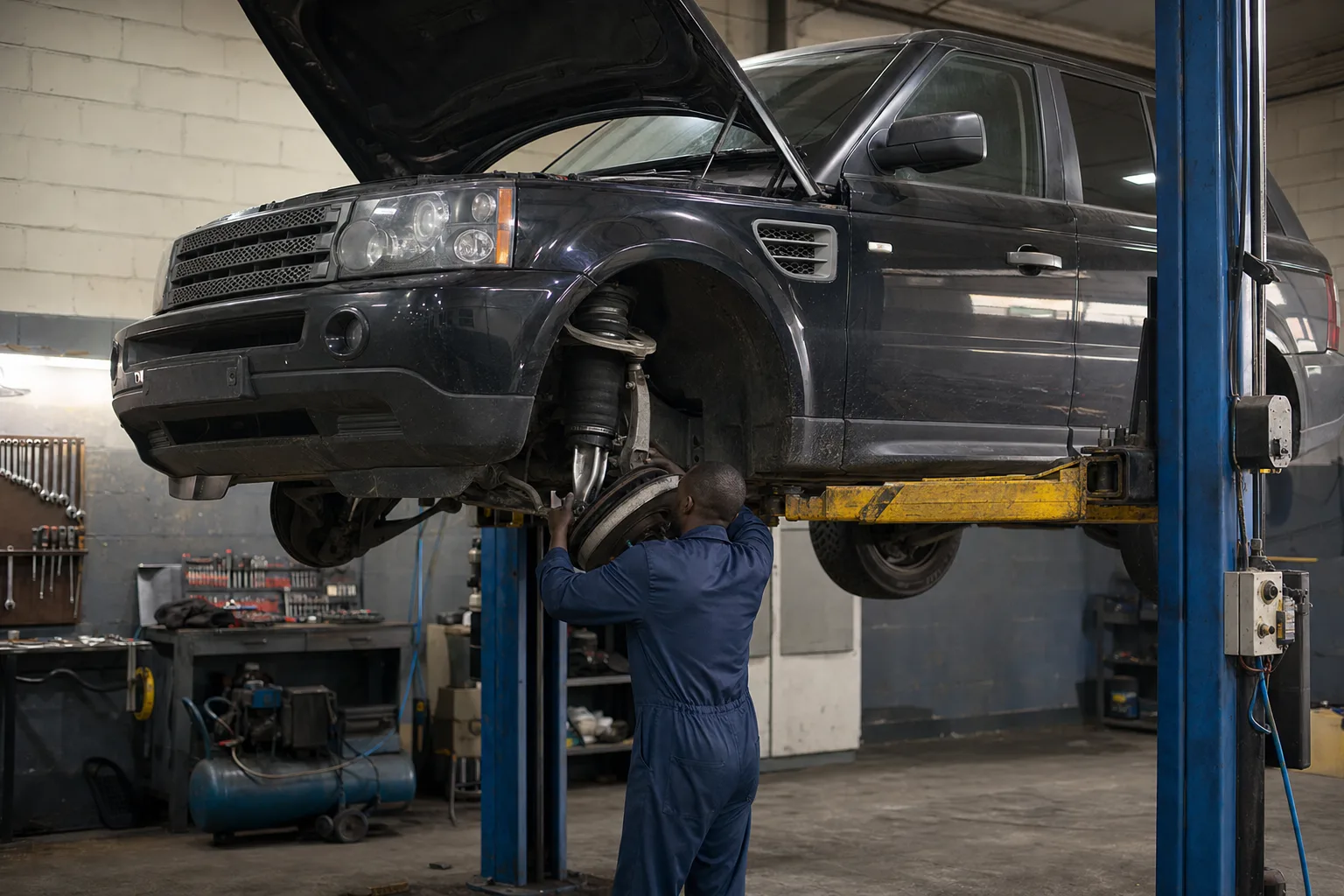

The first-generation Range Rover Sport — the L320, built 2005–2013 — is one of the most tempting used luxury 4x4s in South Africa. It looks the part, drives beautifully and now sells for a fraction of what it cost new. The catch is that a neglected L320 can empty your wallet faster than you can say "suspension fault".
The reassuring news: every common problem on this car is well documented and, in almost every case, the parts are available used or reconditioned here in SA at a fraction of main-dealer prices. Below are the six faults that come up most often on the L320, what they cost to sort, and how to tell a good buy from a money pit before you hand over the cash.
- The L320's biggest engine risk is timing-belt neglect on the 2.7 TDV6 — miss the front and rear belt service and you risk catastrophic engine damage, so demand proof it's been done.
- The air suspension is a wear item, not a lifetime part. The classic mistake is replacing the compressor when the real fault is an air leak somewhere else overworking it.
- The electronic parking brake binds at the drum-in-disc shoe assembly and overloads its actuator — a very common L320 warning.
- Most repairs are far cheaper with quality used or reconditioned parts: an air compressor runs about R4,500–R9,500 fitted versus R16,000+ at a dealer.
- A pre-purchase diagnostic scan (engine, EAS, ABS, parking brake) tells you more than any test drive — buy on condition and history, not just price.
1. 2.7 TDV6 timing belt neglect and lubrication failure
This is the fault that catches out most L320 buyers. The 2.7-litre TDV6 diesel uses a front timing belt plus a separate short rear belt that drives the high-pressure fuel pump.
If either belt is left too long, tensioned incorrectly, or ignored entirely, the results are catastrophic: the rear belt failing can wreck the high-pressure fuel pump and send metal debris through the fuel system, and in the worst cases the engine simply won't start again. Much of the 2.7's undeserved "unreliable" reputation comes down to workshops overtightening the tensioner or skipping the rear belt altogether.
The fix is discipline, not luck. Insist on documented proof the full belt service — front belt, rear belt, tensioners and idlers — has been done at the correct interval by someone who knows the engine. If a car has no history, budget to do the lot as your first job.
When damage has already happened, a tested reconditioned Range Rover Sport engine is far cheaper than a rebuild from a dealer, and we can source the exact TDV6 variant to match your VIN.
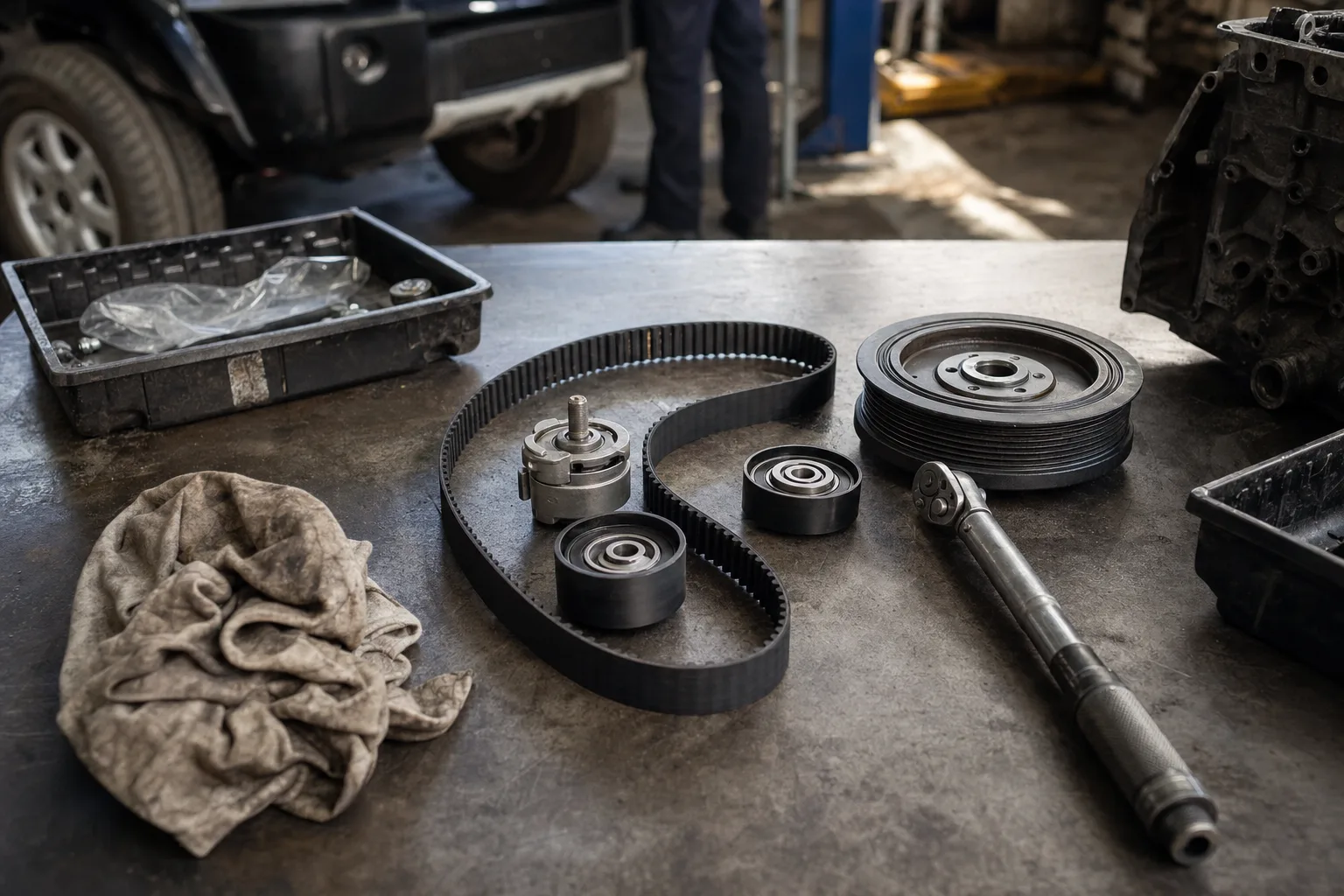
Range Rover Sport L320 Engine Parts
Reconditioned TDV6 and TDV8 engines, timing kits, crank pulleys and turbos for the L320 — the parts that keep this car alive. Send us your VIN and we'll match the exact unit.
Get a Quote2. Air suspension leaks and a tired compressor
The L320 rides on electronic air suspension at all four corners, and it's the second thing owners complain about. The tell-tale signs are the car sitting low on one corner or nose-down after standing overnight, a flashing "suspension fault" message, or the compressor running for ages and never getting the car up to height.
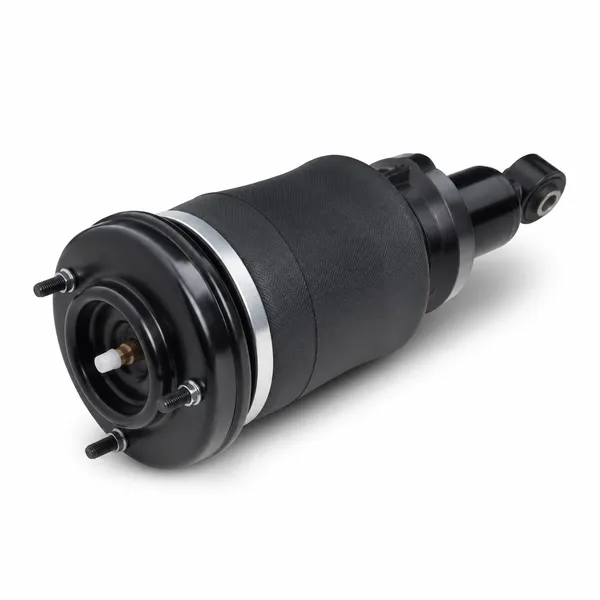
The classic ownership mistake is throwing a new compressor at it first — when the real problem is very often an air leak elsewhere (a perished air spring, a cracked line or a leaking valve block) that has simply worked the compressor to death.
The right approach is to find the leak before you spend a cent on a compressor. A single air spring is inexpensive; the compressor is the bigger ticket, and it's a false economy to replace it while a leak remains. Fitting quality reconditioned air suspension parts keeps the ride exactly as Land Rover intended without dealer pricing. Resist cheap coil-conversion kits unless you fully accept losing the adjustable ride height that makes the Sport so capable.
3. Electronic parking brake binding and faults
The L320 uses an electronic parking brake acting on a drum-in-disc shoe assembly at the rear. Over time the shoes drag and bind, which overloads the parking-brake actuator and its module. Symptoms are a "park brake fault" warning, a brake that won't release, an alarming grinding when it engages, or the actuator straining and failing. Cars that have done real off-road or coastal duty suffer most, because water, mud and salt accelerate the corrosion and drag.
The repair is usually a replacement actuator module and, where the shoes have worn or seized, attention to the drum-in-disc assembly itself. It's an electrical-plus-mechanical job rather than a bank-breaker, and a tested reconditioned module is a sensible buy. As with the suspension, a pre-purchase scan will flag a stored parking-brake code even if the warning light happens not to be showing on the day you view the car — another reason to scan before you buy.
L320 Suspension & Brake Parts
Reconditioned air compressors, new air springs, height sensors and parking-brake modules for the Range Rover Sport L320. Tell us the fault code and we'll match the right part.
Get a Quote4. Turbo, EGR and 3.0 TDV6 crankshaft weakness
On the diesel L320s the turbo and EGR system need watching. The variable-geometry turbos rely on actuators to move their vanes, and over time these stick or the vane mechanism gums up with soot, giving limp mode, power loss or a whistling under load.
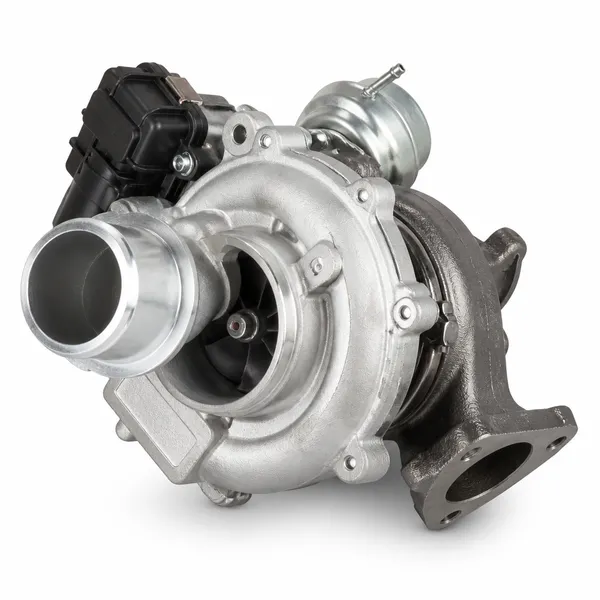
The EGR valves and inlet manifold clog with an oily carbon sludge that causes rough idle, hesitation and poor economy. Separately, the later 3.0 TDV6 has a documented crankshaft weakness — Land Rover issued technical bulletins about premature crank failures on certain engines — so a bottom-end knock on a 3.0 is a serious warning sign. The same twin-turbo diesel thinking applies to the full-size L322 Range Rover, which shares much of this driveline philosophy.
Don't assume every power loss means a new turbo. On the L320 it's frequently the cheaper actuator, a blocked EGR or a split intercooler hose first, and a proper diagnosis before you buy parts saves thousands. When a turbo genuinely is worn, a reconditioned unit restores full performance for far less than new. Browse our Range Rover engine parts or send us the fault codes and we'll tell you honestly what you actually need.
5. 3.6 TDV8 timing chain tensioners and twin-turbo niggles
The 3.6-litre TDV8 fitted from 2007 avoids the belt-service risk of the 2.7 — it runs a timing chain instead — but it brings its own known items. The timing chain tensioners wear with age and mileage, and a rattle on cold start-up is the classic warning that they need attention before the chain jumps.
On top of that the TDV8 is a genuinely complex twin-turbo unit, so injectors, turbo plumbing and the associated sensors all add to the running-cost picture on a high-mileage example.
None of this makes the TDV8 a bad engine — it's smooth and torquey and many go a long way — but it does mean you buy on evidence, not hope. Listen for chain rattle, scan for stored injector and boost faults, and factor a tensioner job into your budget on any car with an unknown history.
Reconditioned tensioner kits, injectors and turbos for the TDV8 are readily available used in SA, so a fault here is a repair, not a write-off.
6. Cooling leaks, oil coolers and voltage-related warning cascades
Rounding out the list are the age-related gremlins every 12-to-18-year-old luxury 4x4 develops. Plastic coolant pipes and the thermostat housing go brittle, the engine oil cooler seeps, radiator and intercooler hoses harden, and a tired battery or weak charging system can throw a whole cascade of unrelated warning lights that panics owners into chasing faults that aren't real.
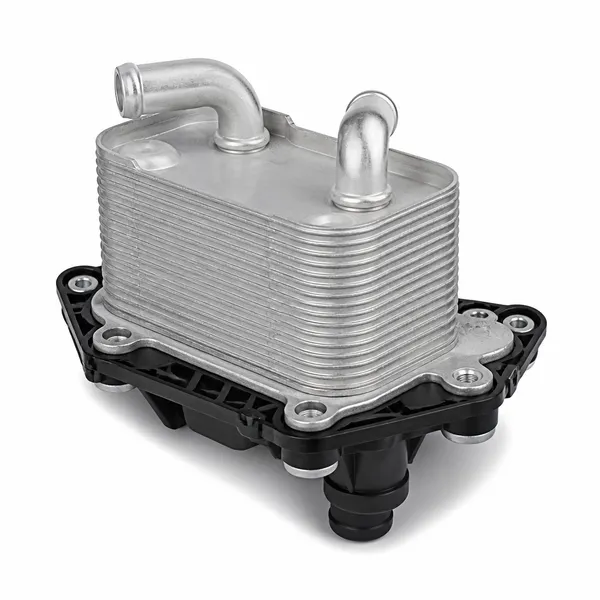
On a heavy diesel that runs hot when towing, cooling-system health matters a great deal — overheating a TDV6 or TDV8 is not a mistake you want to make twice.
The fix is preventative. Replace tired coolant pipes, hoses and the thermostat housing as a batch when the front is already apart for other work, and always check the battery and charging voltage before diagnosing a wall of dashboard warnings.
If you're weighing the L320 against its successors, the same principles carry across to the later L494 Range Rover Sport, which shares much of this thinking. Good used and reconditioned parts make doing it properly once far cheaper than a warped head later.
How much do Range Rover Sport L320 repairs cost in SA?
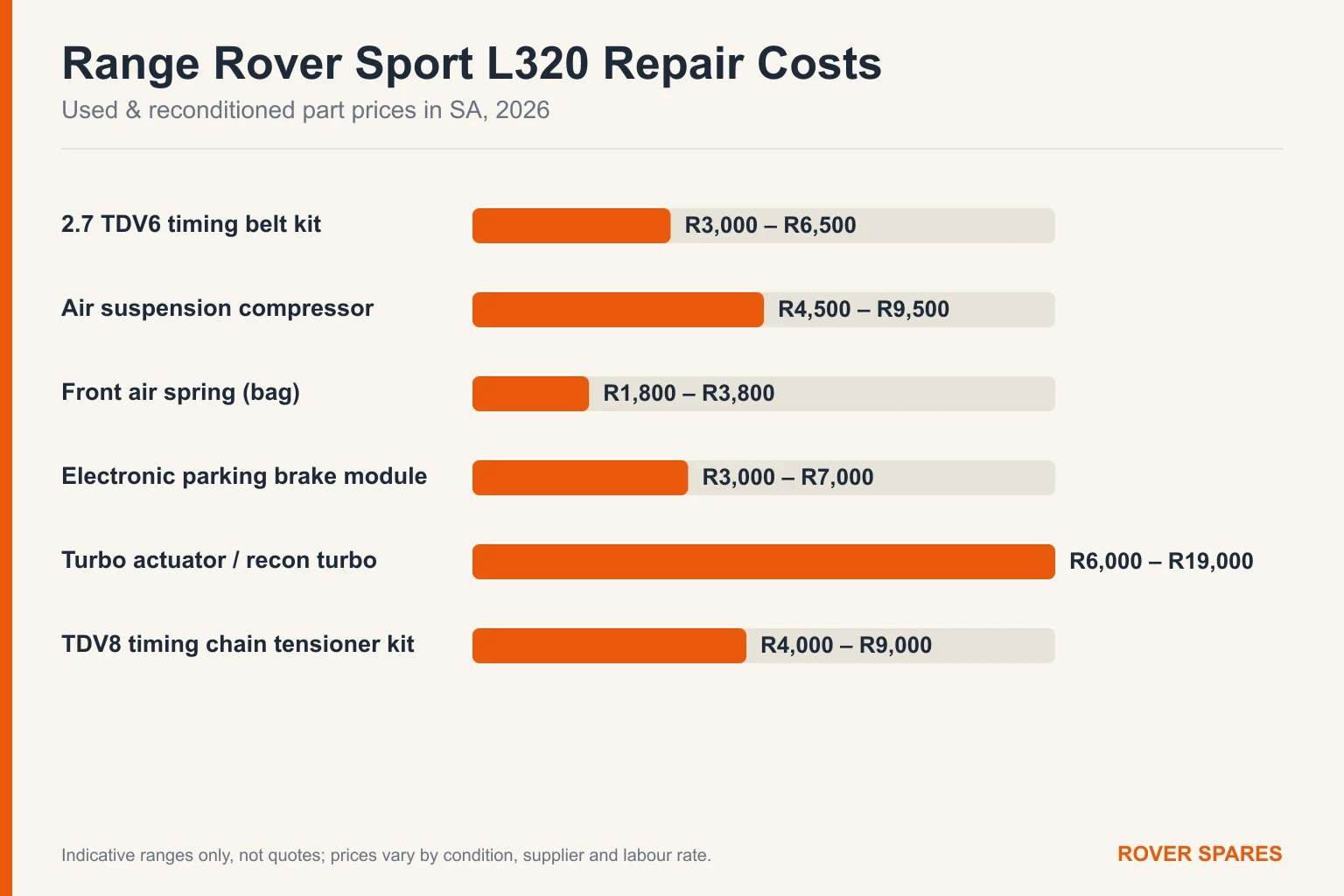
Here's a realistic guide to what these repairs run using quality used or reconditioned parts at an independent workshop — not dealer pricing. Actual figures depend on your exact model, engine, condition and labour rates; these are indicative ranges only, not quotes.
| Repair | Typical part price (used / recon) | Notes |
|---|---|---|
| 2.7 TDV6 timing belt kit | R3,000 – R6,500 | Front + rear belt, do together |
| Air suspension compressor | R4,500 – R9,500 | Vs R16,000+ new at dealer |
| Front air spring (bag) | R1,800 – R3,800 | Per corner |
| Electronic parking brake module | R3,000 – R7,000 | Plus shoes if worn |
| Turbo actuator / recon turbo | R6,000 – R19,000 | Actuator often enough |
| TDV8 timing chain tensioner kit | R4,000 – R9,000 | Listen for cold rattle |
Before you buy parts
On a Sport of this vintage the rubber goes long before the machinery does. Air springs perish, crack along the folds and start leaking, and the vehicle settles overnight on whichever corner has gone. The compressor is often still serviceable, just worn from running constantly to compensate. Do the springs first and in pairs across an axle, because a fresh bag sitting next to a fifteen-year-old one is simply a repeat visit booked in advance. Recondition the compressor rather than buying new. It is the same unit at a fraction of the outlay.
Need Range Rover Sport L320 parts? Get a quote.
We supply used and reconditioned Land Rover Range Rover Sport L320 parts across South Africa — air suspension, TDV6 and TDV8 engine parts, turbos and electronics — with nationwide delivery. Send us your VIN and the part you need.
Frequently asked questions
Is the Range Rover Sport L320 reliable?
The L320 has a mixed reputation, but the reality is more encouraging than the horror stories suggest. Its faults — 2.7 TDV6 belt neglect, air suspension leaks, the electronic parking brake, turbo and EGR issues and the TDV8 chain tensioners — are all well documented and repairable.
An L320 with a real service history and those items sorted is a genuinely rewarding 4x4. A neglected one will nickel-and-dime you. Buy on condition and history, and budget for a couple of catch-up repairs in the first year.
What is the most common Range Rover Sport L320 problem?
Air suspension leaks and 2.7 TDV6 belt-service damage top the list. On the suspension, a car sitting low or a "suspension fault" message is the classic complaint, and the common mistake is replacing the compressor when a leak elsewhere is the real cause. On the 2.7 diesel, a missed or badly done timing belt is the fault most likely to end in a big bill, so always demand proof the full belt service has been done.
Which L320 engine is best, the 2.7 TDV6, 3.0 TDV6 or 3.6 TDV8?
For South African conditions a well-serviced 2.7 or 3.6 diesel is the sensible pick over the thirsty petrol V8s. The 2.7 TDV6 is economical but lives or dies by its belt service; the 3.6 TDV8 is smoother and stronger but watch the timing chain tensioners; the 3.0 TDV6 has a known crankshaft weakness to check for. Whichever you choose, buy on documented history and a clean diagnostic scan.
Are Range Rover Sport L320 parts expensive in South Africa?
New dealer parts are expensive, yes — but that's not your only option. Quality used and reconditioned parts cut the cost dramatically: an air compressor for around R4,500–R9,500 instead of R16,000+, or a timing belt kit for a few thousand rand rather than dealer money. Buying from a specialist that tests its stock is the key to keeping an L320 affordable to run.
Should I convert the L320 air suspension to coil springs?
You can, and some owners do for peace of mind, but think carefully. Coil conversion removes the adjustable ride height — the very thing that makes the Sport capable off-road and easy to load. For most owners, tracing the leak and repairing the air system with good reconditioned parts is the better long-term call. We're happy to talk you through both options honestly before you spend.
How many kilometres can a Range Rover Sport L320 do?
A well-maintained diesel L320 will comfortably pass 300,000 km, and plenty do more. The engines are strong when serviced correctly; what ends most L320s is deferred maintenance on the belts, suspension, turbo and cooling — not the bottom end. Keep on top of the known items with quality parts and it will keep going for years.
Sources
- Honest John — Range Rover Sport (2005–2013) owner-reported good & bad points: honestjohn.co.uk
- Haynes — Range Rover Sport common problems and buying guidance: haynes.com