
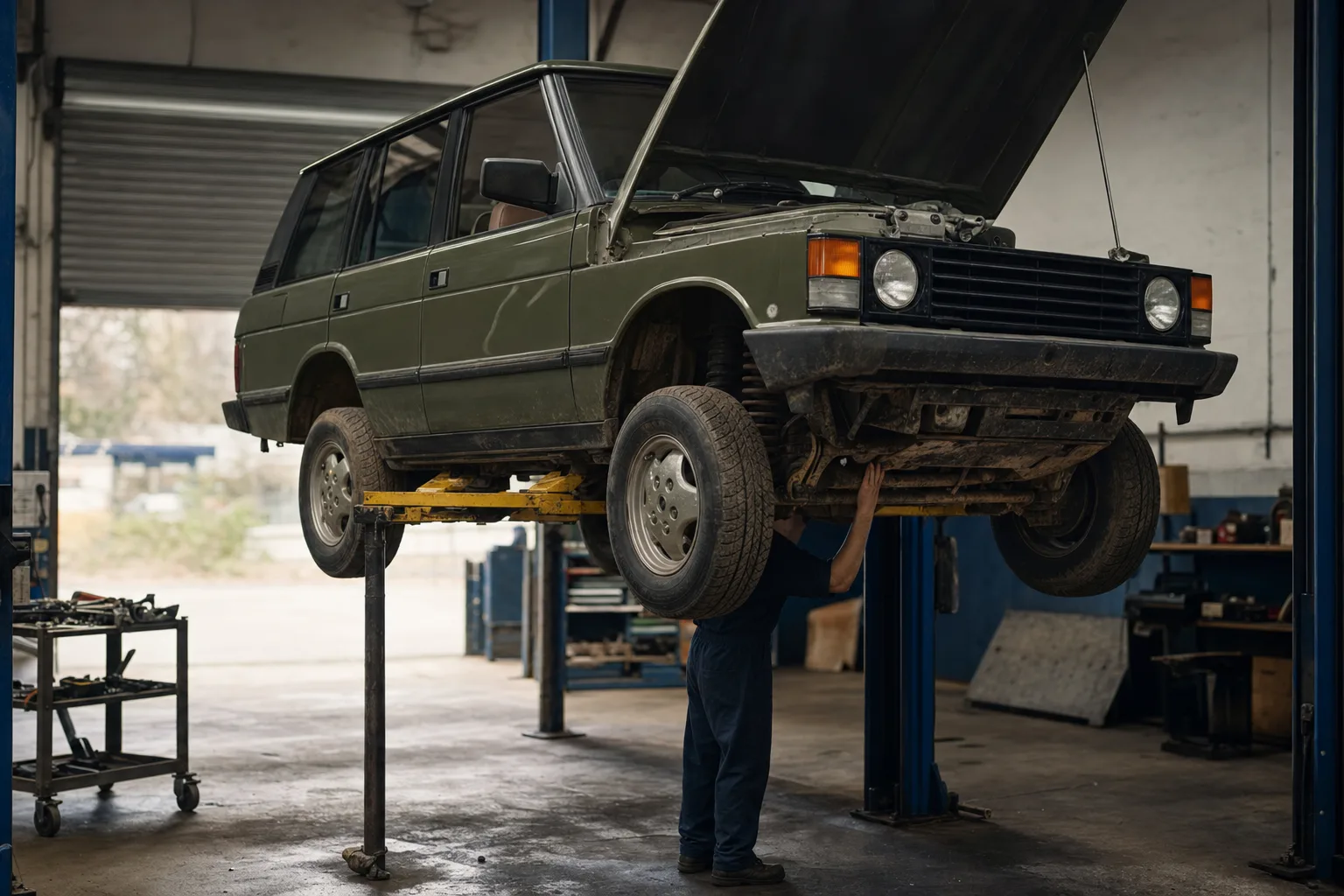

The Range Rover Classic (built 1970–1996) is the truck that started the luxury 4x4 idea, and a good one is a joy to own in South Africa — simple, tough and gloriously old-school.
It is now a 30-to-50-year-old vehicle, and the faults are almost all about age rather than bad design. The Rover V8 can slip a cylinder liner or weep a head gasket, the steel chassis rusts where nobody looks, the Lucas fuel injection throws a wobbly, and the very last cars run air suspension that leaks.
The reassuring part: every one of these is well known and repairable, and quality used or reconditioned parts are far cheaper here than importing new. Below are the six problems that come up most on the Classic, what they cost to sort in rands, and how to spot a bargain from a project that will bleed you dry.
- The Classic's headline risk is the Rover V8 — watch for head gasket weeps and, on neglected or overheated engines, slipped cylinder liners, which is the difference between a service item and a rebuild.
- Chassis and body rust is the real killer — the rear crossmember, outriggers and the joints where steel meets the alloy body corrode, and this decides whether a Classic is worth restoring at all.
- From 1986 the Lucas 14CUX fuel injection can cause hot-start, stalling and rough-running gremlins that are usually sensors, not the whole system.
- Most repairs are far cheaper with quality used or reconditioned parts: a reconditioned V8 short block runs about R35,000–R65,000 versus far more to import a new assembly.
- None of these faults are reasons to avoid a Classic — they are reasons to buy on chassis condition first, engine second, and budget properly for the parts.
1. Rover V8 head gaskets and slipped cylinder liners
The 3.5, 3.9 and 4.2 Rover V8 is a lovely old lump, but it has a well-earned reputation for two related faults. The first is a head gasket weep — oil or coolant seeping at the joint, or coolant loss with no obvious puddle.
The second, more serious one is a slipped or dropped cylinder liner: the aluminium block uses pressed-in iron liners, and after decades of heat cycles (or one bad overheat) a liner can move, letting compression into the coolant. The symptoms are pressurising the header tank, milky oil, misfires and steam from the exhaust.
The good news is that this is a known quantity, not a mystery. A weeping gasket caught early is cheap; a slipped liner means the block comes out for a proper rebuild or a reconditioned replacement.
This is exactly why an alloy V8 must run a correct 50/50 coolant mix all year, even in the Highveld winter, to stop internal corrosion. When a rebuild is genuinely due, fitting reconditioned Rover V8 engine parts keeps a good Classic on the road for a fraction of the cost of chasing new stock overseas.
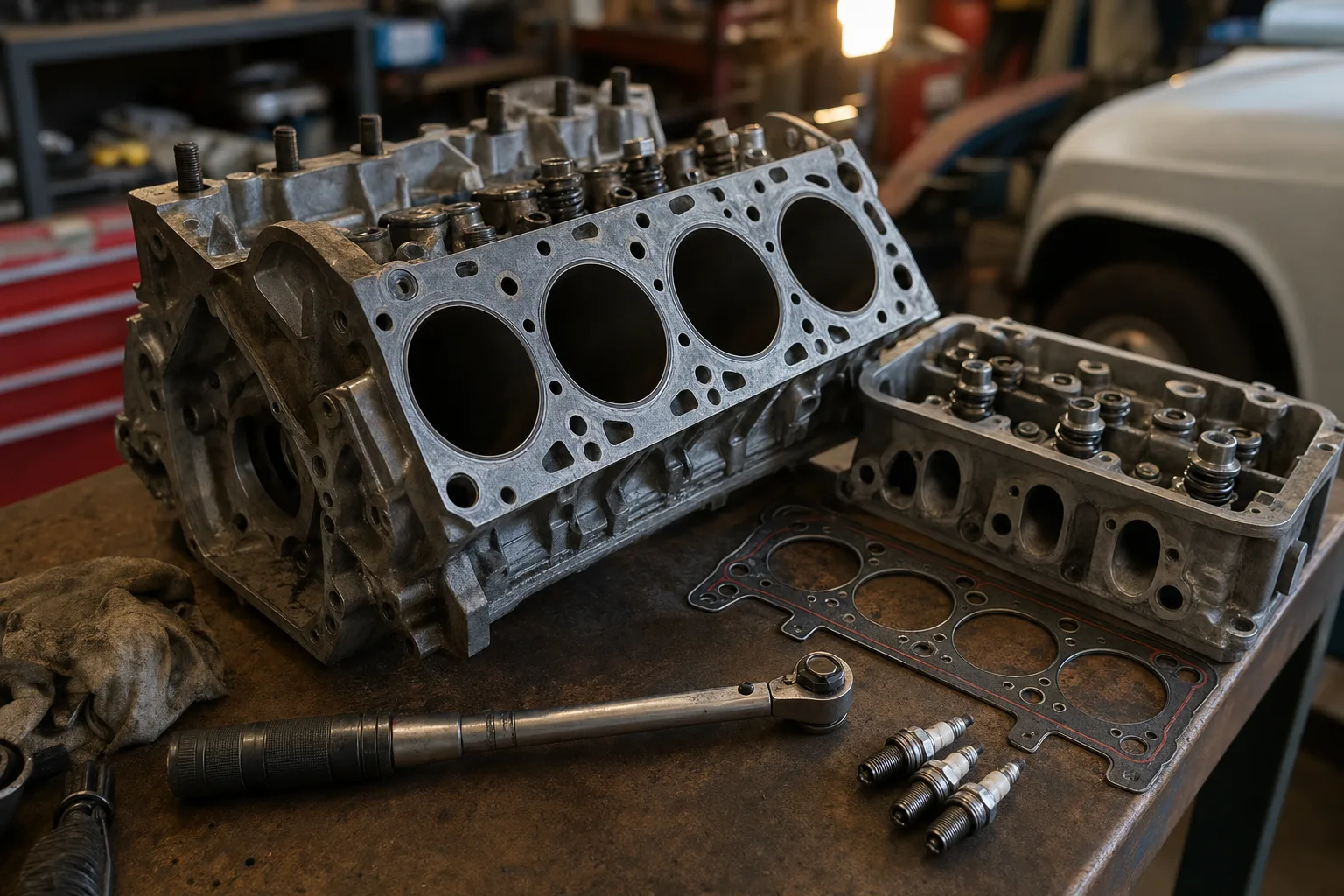
Range Rover Classic V8 Engine Parts
Reconditioned Rover V8 short blocks, cylinder heads, head gasket sets and liners for the 3.5, 3.9 and 4.2 Classic. Tell us your chassis number and we'll match the exact spec.
Get a Quote2. Chassis, crossmember and body rust
If a Classic is going to break your heart, it will be the rust, not the engine. The body outer panels are mostly aluminium and don't rot, but the ladder chassis, the rear crossmember, the outriggers and the boot floor are steel and they corrode badly — especially on coastal cars in Durban or the Cape.
Worse, where the alloy body meets steel fittings you get electrolytic corrosion that eats the metal from the inside out. A shiny, straight-looking Classic can be hiding a chassis that has gone in the places you can't see without a lift.
This is the single most important thing to check before you buy. Poke the rear crossmember, the spring hangers and the sills with a screwdriver, and get the car up on a hoist. A sound chassis with a tired engine is a good buy; a rotten chassis with a fresh engine is a trap.
For panels and steel repair sections, our guide to the older Series Land Rovers covers a lot of the same rust-hunting logic, because these trucks share the same "check the frame first" rule.
3. Lucas 14CUX fuel injection faults
Range Rovers were carburettor-fed until 1986, when Lucas electronic fuel injection arrived, evolving into the 1990–1995 Lucas 14CUX system on the later Classics. It is a robust setup for its age, but three decades on it develops its own gremlins: hot-start problems, stalling at idle, hunting revs, and rough running that comes and goes.
The usual culprits are the airflow meter, the stepper motor that controls idle, tired coolant and air-temperature sensors, corroded earth points and perished vacuum hoses — rarely the ECU itself.
The trap owners fall into is throwing money at the whole system when it's almost always one sensor or a bad earth. A proper diagnosis on the Classic saves thousands, because these parts are individually cheap and widely available used.
If a car has been standing, expect the fuel injection to need a fettle before it runs sweetly. When you do need components, we can supply tested Lucas injection sensors, meters and stepper motors rather than a guess-and-replace box of new bits.
Classic Fuel Injection & Electrical Parts
Lucas 14CUX airflow meters, stepper motors, sensors and relays for the injected Range Rover Classic. Send us your symptoms and we'll match the part that actually fixes it.
Get a Quote4. Overheating and the cooling system
An overheating Rover V8 is the fastest route to the liner and head-gasket trouble in problem one, so cooling health matters more on this engine than almost anything else.
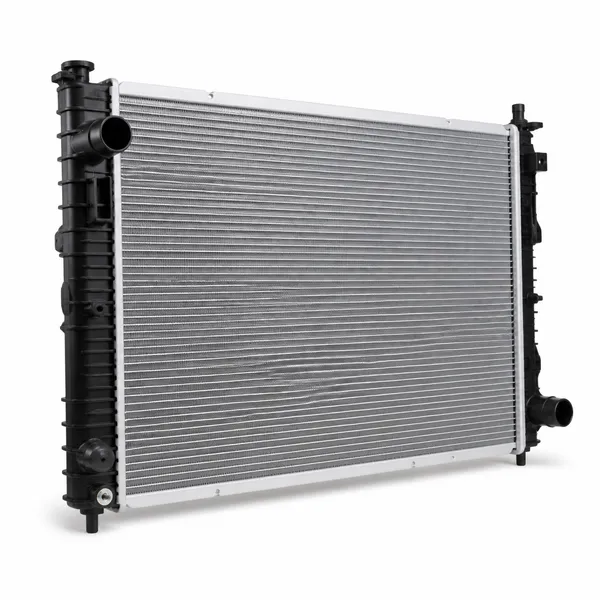
The Classic's cooling system is showing its age: the radiator silts up, the viscous fan coupling gets lazy, the water pump weeps, the plastic-necked expansion tank cracks, and the hoses go hard and split. On a hot Gauteng day, towing a caravan up a pass, a marginal cooling system will let the temperature climb fast.
The fix is preventative rather than dramatic. When you have the front off for anything, treat the radiator, viscous coupling, water pump, thermostat and hoses as a batch and refresh the lot, and always refill with a proper 50/50 antifreeze mix to protect the alloy internals.
Doing this once is cheap insurance against a warped head or a slipped liner later, which is exactly the sort of preventative thinking that keeps a good Range Rover reliable for years rather than months.
5. Electronic air suspension (EAS) on 1993–1996 cars
The very last Classics (the "soft dash" 1993–1996 cars) introduced electronic air suspension, the same idea later refined on the P38.
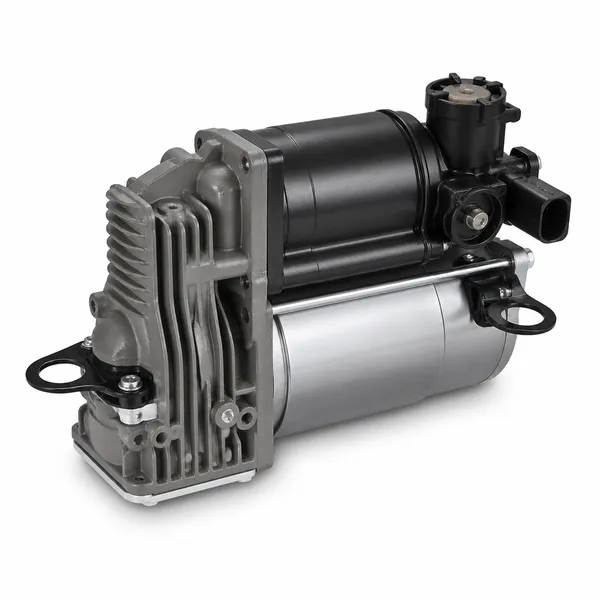
It rides beautifully when healthy, but three decades on the air springs perish, the compressor tires, the height sensors and valve block leak, and you get the classic symptom: the car sitting low on one corner or nose-down after standing, with a suspension fault light. It is the one thing that makes a late Classic more complicated to own than an early coil-sprung one.
None of this is a disaster — the system is repairable corner by corner, and quality reconditioned EAS modules and sensors plus new air springs restore it without dealer pricing. Some owners convert late cars back to coil springs for simplicity, and that is a legitimate choice if you never use the height adjustment.
The air suspension story is almost identical on the model that replaced it, which we cover in our Range Rover P38 problems guide, so the same buying advice applies.
6. Transmission, transfer case and driveline niggles
Rounding out the list are the driveline age issues every high-mileage Classic develops. The LT230 transfer case can whine or leak, the viscous centre coupling seizes and causes transmission wind-up, the autobox (the ZF four-speed on later cars) can be lazy to shift if the fluid has never been changed, and universal joints, propshafts and swivel-ball seals leak.
None of these are unique to the Classic, but on a heavy old 4x4 that has done real off-road duty they all wear together.
The sensible approach is to service the driveline properly rather than chase one fault at a time: fresh gearbox and transfer-case oil, new swivel seals, a serviced viscous coupling and refreshed propshaft joints.
Good used and reconditioned driveline parts make this affordable, and a Classic that shifts and drives cleanly is worth far more than one that clunks. As with the chassis, buy on condition and budget for a catch-up service in the first year.
How much do Range Rover Classic repairs cost in SA?
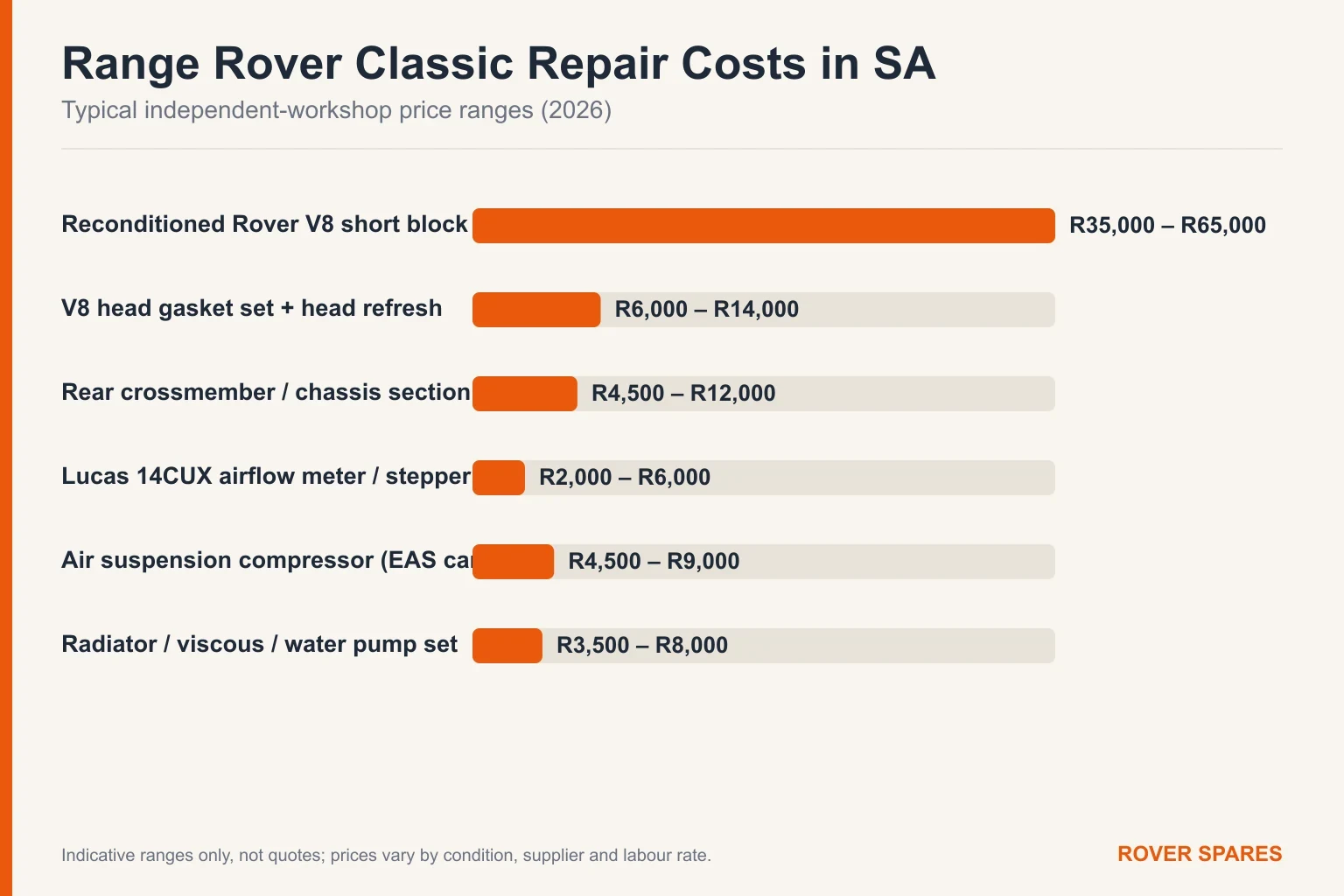
Here's a realistic guide to what these repairs run using quality used or reconditioned parts at an independent workshop — not dealer or import pricing. Actual figures depend on your exact model, condition and labour rates; these are indicative ranges only, not quotes.
| Repair | Typical part price (used / recon) | Notes |
|---|---|---|
| Reconditioned Rover V8 short block | R35,000 – R65,000 | 3.5 / 3.9 / 4.2 |
| V8 head gasket set + head refresh | R6,000 – R14,000 | Per engine, catch early |
| Rear crossmember / chassis repair section | R4,500 – R12,000 | Steel section, plus welding |
| Lucas 14CUX airflow meter / stepper | R2,000 – R6,000 | Sensor often enough |
| Air suspension compressor (EAS cars) | R4,500 – R9,000 | 1993–1996 soft-dash only |
| Radiator / viscous / water pump set | R3,500 – R8,000 | Refresh as a batch |
Before you buy parts
Nothing kills a Classic faster than a cooling system that has been topped up rather than fixed. By the time one is pressurising its header tank, the damage is often already down in the block, and the owner has been told an imported engine is the only route. It is not. The Rover V8 is one of the better-supported used engines in this country, and a tested reconditioned unit costs a fraction of an import with none of the shipping wait. Whichever way you go, renew the radiator, hoses and water pump at the same time or you will do the job twice.
Need Range Rover Classic parts? Get a quote.
We supply used and reconditioned Land Rover Range Rover Classic parts across South Africa — Rover V8 engines, chassis and body sections, Lucas fuel injection, cooling and EAS — with nationwide delivery. Send us your chassis number and the part you need.
Frequently asked questions
Is the Range Rover Classic reliable?
For a vehicle of its age, a well-sorted Classic is genuinely dependable — the mechanicals are simple and everything is fixable. Its weak points (Rover V8 head gaskets and liners, chassis rust, Lucas fuel injection quirks, cooling and the late-car air suspension) are all well documented.
A Classic with a sound chassis, a healthy engine and those known items sorted will serve you for years. A neglected or rusty one will drain you. Buy on chassis condition first, engine second, and budget for a catch-up service.
What is the most common Range Rover Classic problem?
Rust, without question. The steel chassis, rear crossmember, outriggers and the joints where alloy meets steel corrode, and this is what decides whether a Classic is worth owning. The Rover V8's head gasket and liner issues get the headlines, but a good engine in a rotten chassis is money down the drain. Always inspect the frame on a lift before you buy.
Are the Rover V8 cylinder liners a serious problem?
They can be, but they're usually a symptom of neglect or overheating rather than a fault that appears out of nowhere. The alloy block uses pressed-in iron liners that can slip if the engine is badly overheated or run without proper coolant.
Keep the cooling system healthy and use a 50/50 antifreeze mix year-round and a good V8 will run for hundreds of thousands of kilometres. If a liner has gone, a reconditioned short block is the sensible fix.
Are Range Rover Classic parts hard to find in South Africa?
Not through a specialist. New dealer parts are scarce and expensive, but the Classic shares a huge amount with other Land Rovers, and quality used and reconditioned parts are widely available here — Rover V8 components, chassis sections, Lucas injection sensors, cooling and EAS parts. Buying from a specialist that tests its stock is the key to keeping a Classic affordable and on the road.
Should I convert a late Classic's air suspension to coil springs?
Only the 1993–1996 soft-dash cars have air suspension, and you can convert them to coils if you want the simplicity. But you lose the ride-height adjustment, and a healthy EAS system rides beautifully. For most owners, repairing the air system with good reconditioned parts is the better long-term call. We're happy to talk both options through honestly before you spend.
How many kilometres can a Range Rover Classic do?
The Rover V8 will comfortably pass 300,000 km when it's looked after, and the ladder chassis will outlast the engine if it's kept rust-free. What ends most Classics isn't mileage — it's deferred maintenance on the chassis, cooling and fuel system. Keep on top of the known items with quality parts and a Classic will keep going for decades.
Sources
- Honest John Classics — Land Rover Range Rover (1970–1996) buying guide and known good & bad points: classics.honestjohn.co.uk