
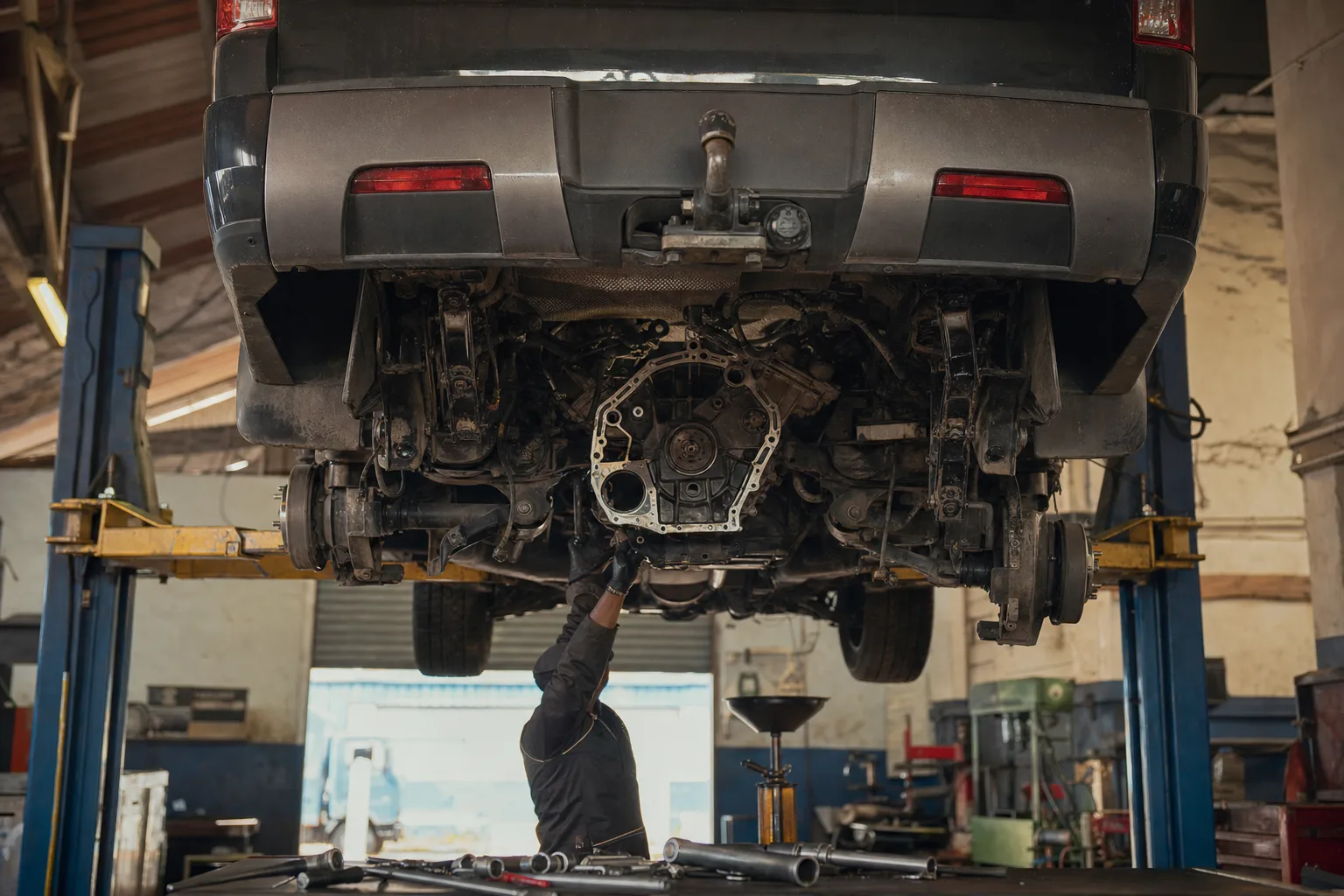

The 4,367 cc diesel V8 — engine code 448DT, badged 4.4 TDV8 and later 4.4 SDV8 — is the big oil-burner in the L322 Range Rover from 2010, and in the L405 Range Rover and L494 Range Rover Sport after that. It is a magnificent thing when it is healthy, and a genuinely expensive engine to get wrong. The good news is that the faults are documented and nearly all of them give warning first.
Below are the six problems that come up most on the 4.4, what they cost to fix in South Africa with quality used and reconditioned parts, and an honest verdict on which version to buy.
- The 4.4's most serious weak spot is the timing chain set at the rear of the engine. A rattle on cold start is your warning, and access is engine-out grade.
- The best-evidenced 4.4-specific fault in owner reports is the engine oil cooler, which leaks externally and can also push oil into the coolant.
- Most repairs are far cheaper with tested used or reconditioned parts: a recon turbo runs about R14,000 – R28,000 versus R45,000+ per side at a dealer.
- Halve the factory service interval. The interval owners cite as the factory figure is 16,000 miles (about 26,000 km); owners and specialists near-universally run half that or less.
- Within the L322, the 2010–2012 4.4 TDV8 is the diesel to have over the 2006–2010 3.6, and no Land Rover Discovery ever got a diesel V8 at all.
TDV8 or SDV8 — what's the difference?
People use the two badges as if they are different engines. They are not. The 4.4 TDV8 and the 4.4 SDV8 are the same 4,367 cc twin-turbo diesel V8 from the Ford/PSA "Lion" AJD-V8 family; the SDV8 is simply that engine in a higher state of tune.
- 3.6 TDV8 (368DT) — 3,630 cc, 272 PS (200 kW) and 640 Nm. Fitted to the L322 Range Rover from 2006 to 2010, and to the first-generation L320 Range Rover Sport.[3]
- 4.4 TDV8 (448DT) — 4,367 cc, 313 PS (230 kW) and 700 Nm. It replaced the 3.6 in the L322 and ran from 2010 to 2012.
- 4.4 SDV8 — the same 4,367 cc unit in a higher state of tune, 339–340 PS (335 hp) and 700 Nm at launch, raised to 740 Nm for the 2015 model year, in the L405 Range Rover and the L494 Range Rover Sport.
One myth is worth killing here, because we see it repeated constantly in classifieds: the diesel V8 was never fitted to a Discovery. No Land Rover Discovery of any generation left the factory with a diesel V8. If a listing claims a Discovery 4 TDV8, it is a 3.0 V6. For the wider picture on the car this engine lived in longest, see our rundown of the L322 Range Rover's known problems.
1. Timing chain wear at the rear of the engine
This is the big one, and the reason the 4.4 has the reputation it does. The chains are not at the front of the engine where you would expect them, and owners who have done the job report the engine bay gives no useful side access, so getting to them is an engine-out or near-enough job.
One detail is worth flagging, with the caveat that it rests on a single owner account rather than published Land Rover data: an experienced owners'-forum member reports that one bank runs a simplex (single-row) chain while the other runs a stronger duplex (double-row) chain — and it was the simplex bank that failed on the car in question. We could not corroborate it anywhere else, so confirm your kit against your VIN rather than assuming a matched pair.
The documented worst case in owner reports is a 2014 Range Rover Sport 4.4 at roughly 110,000 miles with the left-bank chain completely gone. The warning sign is a rattle or chatter from the rear of the engine on a cold start that fades as oil pressure builds.
Be sceptical of anyone selling you an "upgraded" chain kit on the strength of a factory bulletin. We can find no published Land Rover technical bulletin or superseded part number for a diesel V8 chain upgrade, so buy on VIN match and part quality rather than on an upgrade claim. What we can tell you is that on any Range Rover V8 diesel, a cold-start rattle is a walk-away-or-negotiate-hard finding.
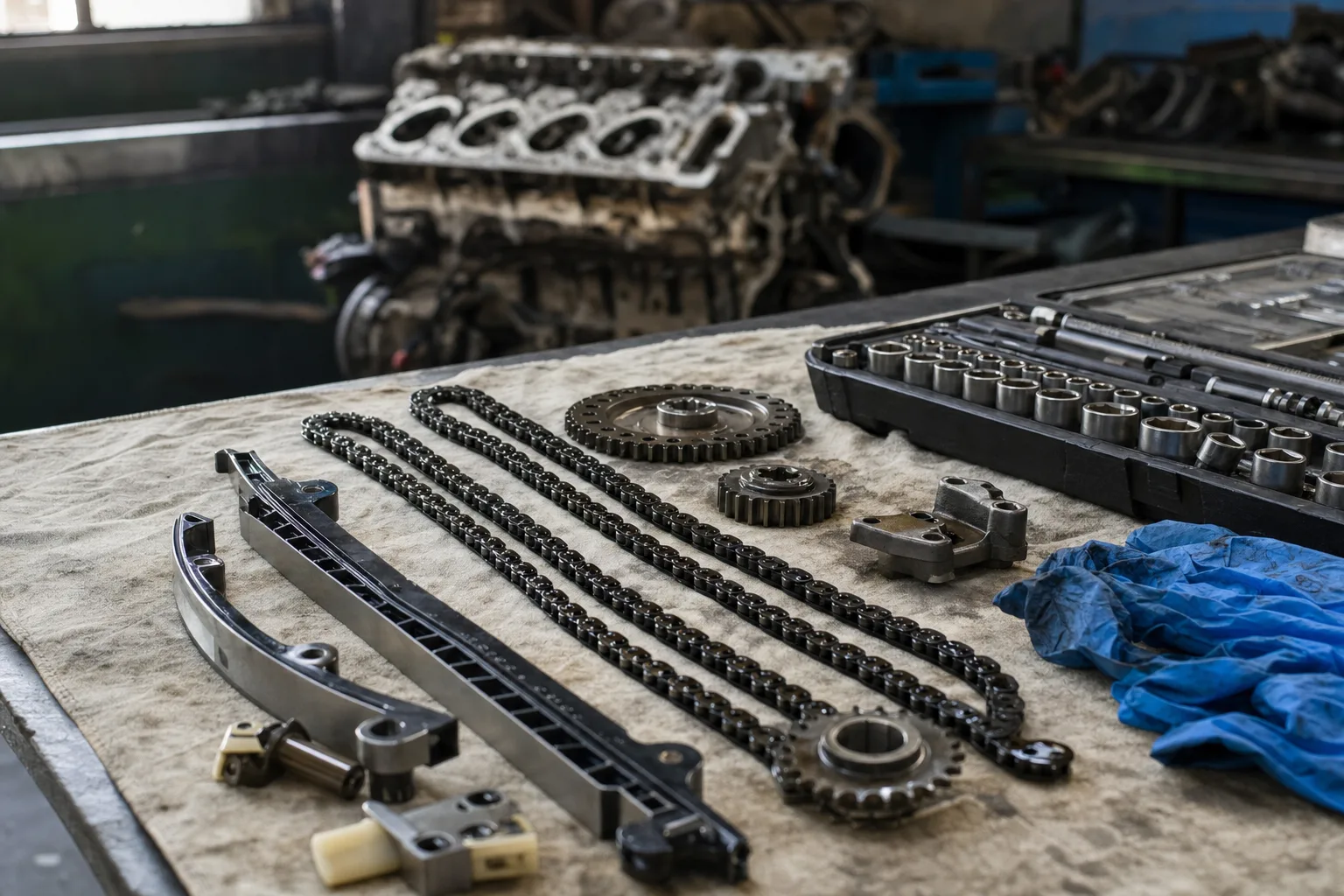
4.4 Diesel V8 Timing Chain Kits
Chains, tensioners, guides and sprockets for the 448DT V8 diesel, matched to your VIN and build year. Send us both and we'll confirm the exact kit before you buy.
Get a Quote2. Engine oil cooler leaks
If you go by weight of owner evidence rather than folklore, the oil cooler is the best-documented fault specific to the 4.4. It fails in two ways, and the second one is the nasty one.
- External leak — oil weeping down the back or the side of the block, a burning smell after a run, and drips on the driveway.
- Internal leak — oil pushed into the coolant, giving you an oily film or a mayonnaise-coloured sludge in the header tank.
The internal failure is the one to check for before you buy. Pull the expansion tank cap on a cold engine and look at the underside of the cap and the coolant surface. Oil in the coolant on a 4.4 points at the oil cooler far more often than it points at a head gasket, but either way it is a stop-and-diagnose finding, not something to drive on.
The part itself is not a bank-breaker; the labour to reach it is what stings, so it is worth doing the cooler, its seals and any tired hoses in one go rather than twice. That is exactly the sort of job where the genuine-versus-aftermarket decision matters, and we have set out how we weigh it in our guide to choosing between genuine, quality aftermarket and used Land Rover parts.
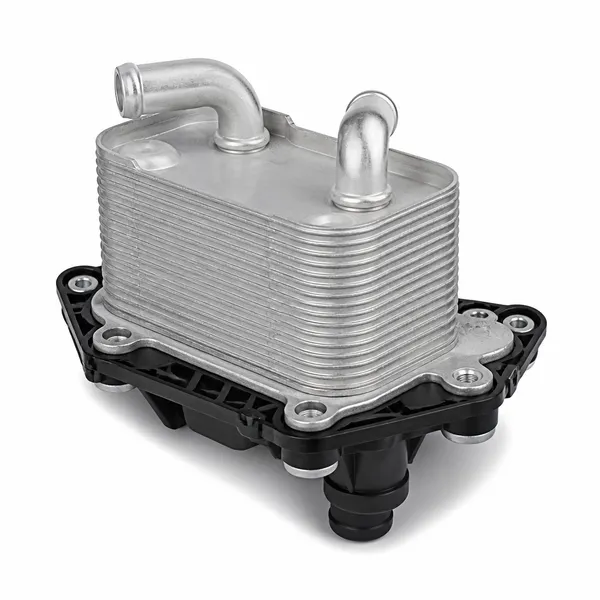
Oil Coolers, Seals & Filter Housings
Tested oil coolers, seal sets and filter housings for the 448DT V8 diesel, the parts behind most oil-in-coolant and external oil-leak complaints. Tell us your VIN and we'll match the right unit.
Get a Quote3. Turbos, boost hoses and the VGT actuator
The 4.4 is twin-turbocharged, with variable-geometry turbos whose vanes are moved by an electronic actuator. Limp mode, lost boost, black smoke or a whistle under load will all send you looking at the turbos. Slow down before you buy any.
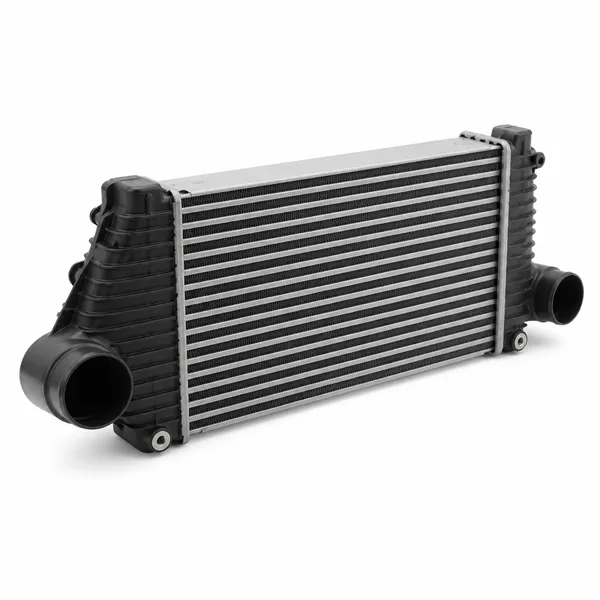
On this engine the usual culprit is cheaper than a turbo. Experienced owners report that a sticking actuator does happen but is not a common fault, and that a split intercooler or boost hose is the more usual reason a 4.4 drops into limp mode. Worth knowing too: the catastrophic turbo failure that defines the 3.6 does not appear to carry over to the 4.4, and the forum evidence points the opposite way.
What we would check, in this order:
- Boost-deviation and actuator fault codes on a proper scan, not a generic code reader.
- Every intercooler and boost hose, by hand, for splits and oil residue.
- Actuator movement and free play, before condemning the turbo itself.
- Shaft play, and oil in the intercooler piping, which is the genuine worn-turbo sign.
Send us the fault codes with your enquiry and we will tell you honestly whether you need a turbo or just the bits around it.
4. EGR coolers and inlet carbon build-up
Like every modern diesel, the 4.4 recirculates exhaust gas, and the EGR coolers and inlet tract slowly choke with an oily carbon sludge. Symptoms are rough running, hesitation, poor economy and warning lights, and a cracked EGR cooler can start leaking coolant internally.
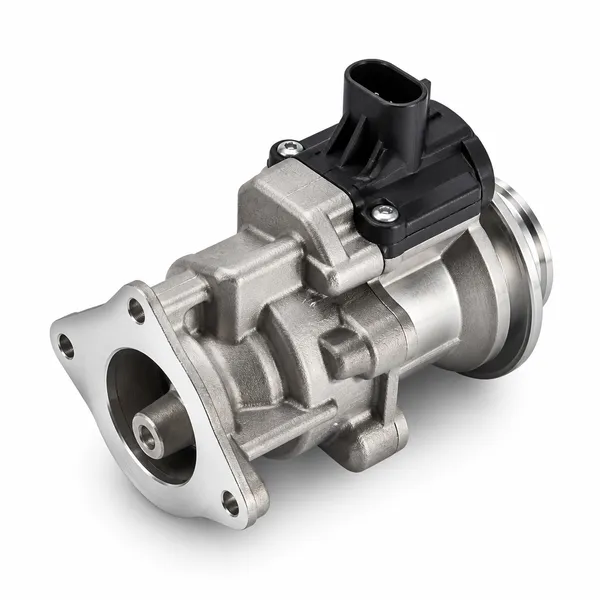
There is a second reason to care about soot on this engine, and it is not about running rough. Soot that gets past the oil and settles in the sump can block the oil pickup strainer, and a blocked strainer is one mechanism owners propose for the bearing failures covered further down — plausible, but we have not found a primary account that confirms it. On a V8 diesel the EGR system is a maintenance item, not a fit-and-forget one.
A thorough clean and, where needed, replacement coolers and valves usually restore things without opening the engine. Regular longer runs at highway speed genuinely help, and a scan before you buy will flag stored EGR and boost codes even on a car that feels fine over a ten-minute test drive. You will find coolers, valves and inlet parts among our Land Rover engine parts.
5. Oil dilution from DPF regeneration
This one is central to living with a 4.4 diesel, and most owners only learn about it after the fact. To burn off the diesel particulate filter, the engine injects extra fuel late in the cycle. Some of that fuel washes past the piston rings and ends up in the sump, thinning the oil.
The vehicle keeps a running calculation of how badly diluted the oil is, and the service counter triggers at roughly 7% calculated dilution. The numbers owners report are eye-opening: one owner's 43 km (27-mile) commute took 725 km off the service counter, and a later 84 km trip wiped out the 4,780 km he had left, because a short journey means a regeneration that never properly completes.
The practical consequences for a South African owner:
- School-run and city-only use is the worst possible diet for this engine.
- A rising oil level on the dipstick, or oil that smells of diesel, is a dilution warning.
- Distance-based service intervals mean very little if your trips are short. Go by the counter and by time.
None of this is a design scandal. It is how a DPF-equipped diesel works. It just means the maintenance schedule you actually need is not the one printed in the book.
6. Big-end and main bearing failure (the honest version)
The failure owners fear most after the timing chain is a spun big-end or worn main bearings, usually announced by a deep knock from the bottom of the engine. We want to be careful about how we describe it, because a lot of confident nonsense is written on this subject.
What the owner evidence actually supports:
- Individual cases are real and first-hand, at mileages from roughly 120,000 to 240,000 km (75,000 to 150,000 miles).
- The mechanism reported is oil starvation. Experienced owners put it down to dirty oil and a low sump level rather than any design fault.
- It is not established as statistically common across the fleet, and there is no evidence of a manufacturing defect behind it.
A negative finding is worth adding too. Oil pump seizure gets blamed on this engine a lot, and one experienced owners'-forum member answers flatly that oil pumps seizing are not common. He was answering an owner whose 2014 L405 4.4 SDV8 did seize its pump at 75,000 miles and needed a new crank, pistons, liners and pump — so "uncommon" is not "impossible".
Treat a low-oil-pressure warning or a bottom-end knock as a stop-driving-now event either way. Where a bottom end genuinely is gone, a tested low-mileage replacement Land Rover engine is usually the sensible route rather than a piecemeal rebuild.
Is the 4.4 SDV8 reliable? The honest verdict
Short answer: yes, conditionally, and the conditions are all about oil. This engine rewards a shorter service interval and punishes short-trip use, and outcomes track maintenance far more closely than they track model year.
Which one to buy
There is exactly one year cutoff we are prepared to defend. Within the L322, the 2010–2012 4.4 TDV8 is the diesel to have over the 2006–2010 3.6, and there is a documented technical reason for it.
Land Rover moved to Honeywell TwoStage Parallel twin turbos for the 2011 4.4, the first use of that architecture on any V8.[1]
The 4.4 also brought the ZF 8HP70 eight-speed; the 3.6 had run the six-speed ZF 6HP26, and owners generally rate the eight-speed the more dependable box.
Beyond that cutoff, be suspicious of anyone naming a specific SDV8 "year to avoid". We went looking, and could not corroborate a single one from a credible source. Buy on history and evidence, not on a build year.
The service interval is the whole game
The interval owners cite as the factory figure is 16,000 miles or 12 months, roughly 26,000 km, though we could not confirm it against a Land Rover service document.
Owners and independent specialists across four separate platforms run half that or less — 8,000 miles, about 13,000 km, is the common landing point, and plenty go to 10,000 km. That is the single most actionable thing on this page.
Oil spec is a low-SAPS SAE 5W-30 to the Land Rover specification listed in your handbook — later cars call for STJLR.03.5005, earlier ones Ford WSS-M2C934-B — and capacity is around 9.4 litres, so short intervals are not cheap. They are still far cheaper than bearings.
On oil dilution and bearings
Dilution is the leading explanation owners offer for bearing failures, and the mechanism is plausible. It is not proven. One owner who spun a big-end had measured dilution below 7% and was changing oil every 6,000 miles. Shorter intervals are still the right call. They are just not a guarantee.
A useful negative on recalls
We checked the UK DVSA register for Range Rover and found no engine-mechanical safety recall — the campaigns listed are airbags, seat belts, an instrument cluster, a fuel rail, security and a front suspension knuckle.
Read the US NHTSA silence with care, though: the 4.4 diesel V8 was never certified for the American market, so its absence there tells you nothing about the engine.
There is NHTSA campaign 19V040000 (JLR reference N276, begun 12 February 2019), covering a crankshaft pulley retaining bolt that may fracture on 2019 Range Rover, Range Rover Sport, Velar and Discovery models with "V6 or V8 engines".[2] NHTSA describes them only as "V6 or V8 engines" without naming the variant, so it is not "the SDV8 recall", and it cannot apply to the 3.6 at all.
The dissenting view, because it deserves airtime. Owner consensus favours the 4.4, on the logic that the 3.6's headline failure is catastrophic and uneconomic while the 4.4's faults are gradual and fixable. That consensus is not unanimous.
A substantial thread on FullFatRR argues the opposite: that the 3.6's one major fault is preventable with sensible EGR and hose maintenance, while the 4.4 is "death by a thousand cuts". If you want the other side of that argument in full, our write-up of the 3.6 TDV8's known issues covers it.
What we would check on any car before handing over money:
- Cold start from properly cold, listening at the rear of the engine.
- Oil in the intercooler hoses, and every boost hose checked by hand for splits.
- Coolant level, and the underside of the expansion tank cap for oil.
- Service records with dates, not just stamps, and evidence of shortened intervals.
- A full fault-code scan including stored and historic codes.
How much do 4.4 SDV8 repairs cost in SA?
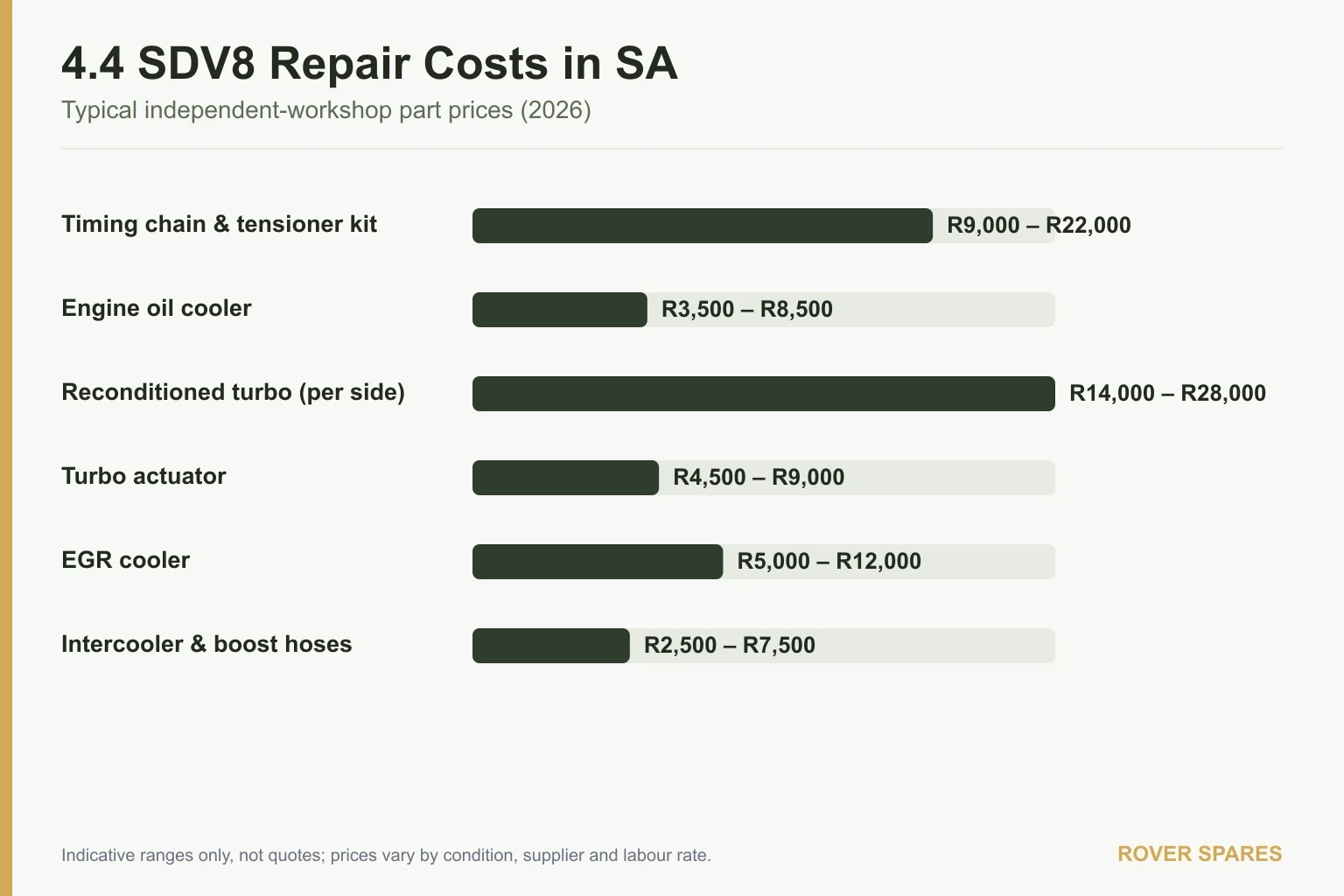
Here is a realistic guide to what these repairs run using quality used or reconditioned parts at an independent workshop, not dealer pricing. Actual figures depend on your exact model year, condition and labour rates. These are the ranges our suppliers were quoting in 2026.
| Repair | Typical part price (used / recon) | Notes |
|---|---|---|
| Timing chain & tensioner kit | R9,000 – R22,000 | Engine-out labour extra |
| Engine oil cooler | R3,500 – R8,500 | Do the seals at the same time |
| Reconditioned turbo (per side) | R14,000 – R28,000 | Vs R45,000+ new at dealer |
| Turbo actuator | R4,500 – R9,000 | Often enough on its own |
| EGR cooler | R5,000 – R12,000 | Clean can be cheaper |
| Intercooler & boost hoses | R2,500 – R7,500 | Common limp-mode cause |
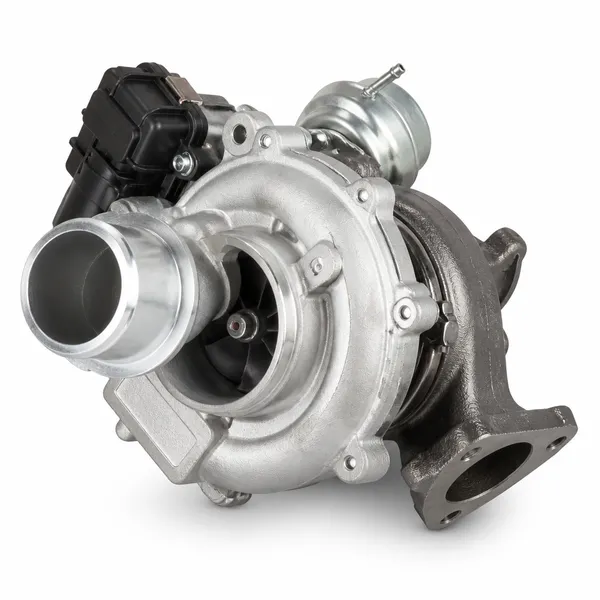
Recon Turbos, Actuators & Boost Hoses
Tested reconditioned units from our Land Rover turbocharger stock, plus VGT actuators and the boost hoses behind most limp-mode faults. Send your fault codes and we'll quote only what you actually need.
Get a QuoteBefore you buy parts
The pattern to watch on 4.4 chain jobs is bundling. Because getting to the chains is such a heavy strip-down, quotes routinely arrive with turbochargers, an oil cooler and anything else in the vicinity added on the reasoning that the engine is open anyway. Sometimes that is genuinely the right call and saves a second labour bill later. Often it is not, and the customer is paying for parts that were working fine. Our advice is to make the quote itemised: ask which of those parts has actually been tested or measured as faulty, and which are being replaced on convenience. Then price the itemised list against used and reconditioned equivalents. The labour is the same either way; the parts bill is where this job is won or lost.
Need 4.4 SDV8 parts? Get a quote.
We supply used and reconditioned Land Rover 4.4 SDV8 (448DT) parts across South Africa — timing chain kits, turbos, oil coolers, EGR coolers and complete engines — with nationwide delivery. Send us your VIN and the part you need.
Frequently asked questions
What is the difference between the 4.4 TDV8 and 4.4 SDV8?
They are the same 4,367 cc twin-turbo diesel V8 (engine code 448DT), not two different engines. The 4.4 TDV8 produced 313 PS (230 kW) and 700 Nm and ran in the L322 Range Rover from 2010 to 2012, replacing the 3.6 TDV8 that had been fitted from 2006.
The SDV8 is that same 4,367 cc unit in a higher state of tune, 339–340 PS (335 hp), making 700 Nm at launch and 740 Nm from the 2015 model year, used in the L405 Range Rover and L494 Range Rover Sport. The weak points are shared, so the same maintenance advice applies to both.
Does the 4.4 SDV8 have a timing belt or a timing chain?
A chain, not a belt, and it sits at the rear of the engine rather than at the front. There is a quirk worth knowing when you buy parts, though it rests on a single owner account rather than published Land Rover data: one bank is reported to run a simplex (single-row) chain and the other a duplex (double-row) chain, so confirm the correct kit against your VIN rather than assuming a matched pair.
Because of the rear mounting, replacement is an engine-out or near-enough job, which is why a cold-start rattle from the back of the engine matters so much on this motor.
Is the Land Rover 4.4 SDV8 engine reliable?
It can be, and the deciding factor is oil rather than luck. Its documented faults, the rear timing chains, the oil cooler, turbo and boost-hose issues, EGR carbon build-up and oil dilution from DPF regeneration, all give warning before they become terminal. What separates a good one from a bad one is a shortened service interval and evidence of longer runs rather than city-only use. Buy on records and condition, not on the promise of a particular model year.
What is the most common 4.4 SDV8 problem?
By weight of owner evidence, the oil cooler is the best-documented fault specific to the 4.4, leaking externally and sometimes pushing oil into the coolant. The timing chain set at the rear of the engine is the most serious one, because access is engine-out grade and the failure can be terminal. Listen for a cold-start rattle from the rear, and check the expansion tank cap for oil, before you buy.
Why does the 4.4 SDV8 timing chain fail?
Chain, guide and tensioner wear on a hard-working diesel V8 comes down to oil condition and oil pressure, which is why short service intervals matter so much on this engine. Once a chain starts to slap it stretches and can jump a tooth.
The documented worst case in owner reports is a 2014 Range Rover Sport 4.4 at roughly 110,000 miles with the left-bank chain completely gone. We are not aware of any published Land Rover bulletin describing an upgraded diesel V8 chain tensioner, so treat that claim with caution if a seller makes it.
Are 4.4 SDV8 parts expensive in South Africa?
New dealer parts are expensive, but that is not your only route. Quality used and reconditioned parts cut the cost sharply: a recon turbo for roughly R14,000 – R28,000 instead of R45,000+ per side, or a timing chain kit for a fraction of dealer pricing. The trick is buying from a specialist that tests its stock and matches parts to your exact build year.
Should I buy a 4.4 SDV8 with no service history?
Be very cautious. On this engine, service history is worth real money, because oil quality and oil-change frequency determine whether the bottom end and the chains last. A car with no records could be perfect, or it could be a chain and bearing job waiting to happen.
If you do buy one, budget upfront for a full service with the correct low-SAPS 5W-30 to the spec in your handbook, an oil analysis and a proper fault-code scan, so you start from a known baseline.
How many kilometres will a 4.4 SDV8 last?
There is no honest fixed number, and anyone quoting one is guessing. Well-maintained 2011 4.4 TDV8s reaching 100,000 miles with only minor issues are reported by owners, but those are self-selecting accounts from people who look after their cars.
What the evidence does support is that outcomes track maintenance rather than model year: halved service intervals, longer runs instead of short hops, and no ignored rattles or leaks. Get those right and the engine keeps going. Get them wrong and it will not.
Sources
- Automotive Industries — Honeywell press release on the TwoStage Parallel turbo technology launched on the 4.4 V8: ai-online.com
- NHTSA — recall campaign 19V040000 (JLR reference N276), crankshaft pulley retaining bolt: api.nhtsa.gov
- Fleet News — 2006 Range Rover TDV8 road test, with the 3.6 TDV8's original output figures: fleetnews.co.uk