
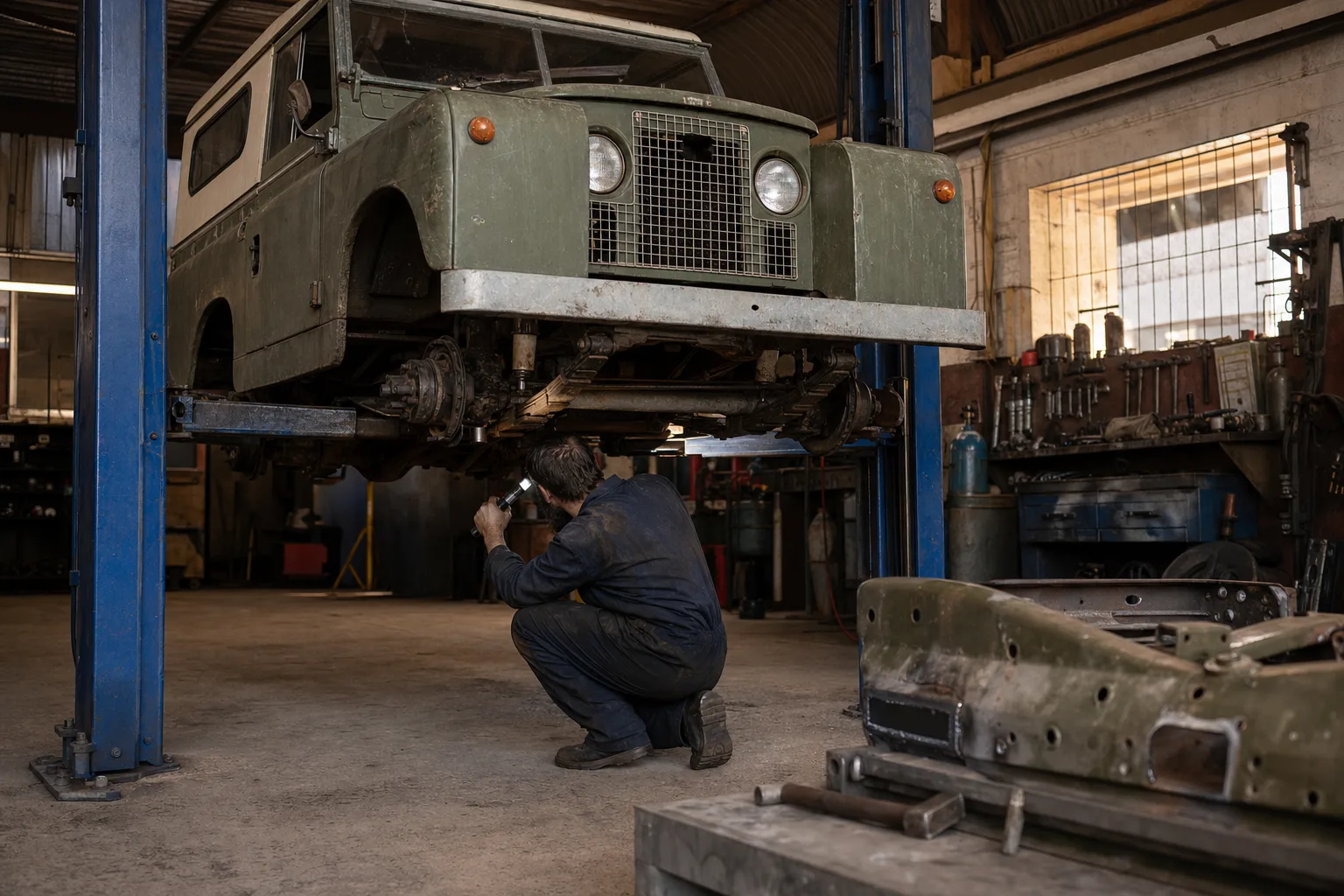

The Land Rover Series II and IIA (built 1958–1971) is the shape most people picture when they hear "Land Rover" — the barrel-side, aluminium-bodied workhorse that helped build farms and game reserves across South Africa. As a classic it is wonderfully simple to keep going, but almost every fault it develops comes down to one thing: age.
The aluminium body barely rusts, yet the steel chassis, bulkhead and swivels underneath do. The good news is that these are honest, mechanical problems with no computers to fight, and the parts are cheap and plentiful used and reconditioned here in SA.
Below are the six issues our workshop sees most on the Series II, what they cost to sort, and how to tell a solid restoration project from a rust trap.
- The Series II's biggest killer is chassis and bulkhead corrosion — the aluminium body fools people, but the steel underneath (outriggers, crossmember, bulkhead footwells) is where the money hides.
- Front swivel balls and kingpins wear and pit, causing steering slack and oil leaks onto the brakes — a classic MOT-style failure that is cheap to catch early.
- The 2.25 petrol and 2.25 diesel engines are tough and rebuildable, but overheating, oil leaks and worn timing gear are the usual age-related niggles.
- Most repairs are far cheaper with quality used or reconditioned parts: a reconditioned swivel housing kit runs about R1,500–R3,500 per side versus main-dealer classic pricing.
- None of these faults are reasons to avoid a Series II — they're reasons to inspect the chassis properly before you buy and budget for the parts smart.
1. Chassis corrosion (outriggers, crossmember and spring hangers)
If a Series II is going to break your heart, it will do it through the chassis. The box-section steel frame traps mud and water, and after sixty-odd years the classic rot spots are the outriggers that hold the body to the chassis, the rear crossmember, the front dumb-irons, and the spring hangers and damper mounts.
On a bakkie that has done real farm duty in a wet coastal area, you can find a chassis that looks solid from a metre away but crumbles when you tap it with a screwdriver. The aluminium body hides all of this, which is exactly why so many buyers get caught.
The important thing to understand is that a Series II chassis is entirely repairable — outriggers and crossmembers are bolt-and-weld replacement panels, and a galvanised replacement chassis is a well-trodden option for a full restoration. Buy on the chassis, not the paint.
If you're weighing up which era to restore, our notes on the earlier Series I's weak spots show how much stronger the parts supply is for the later Series II. Always get underneath with a torch and a spike before you hand over money.
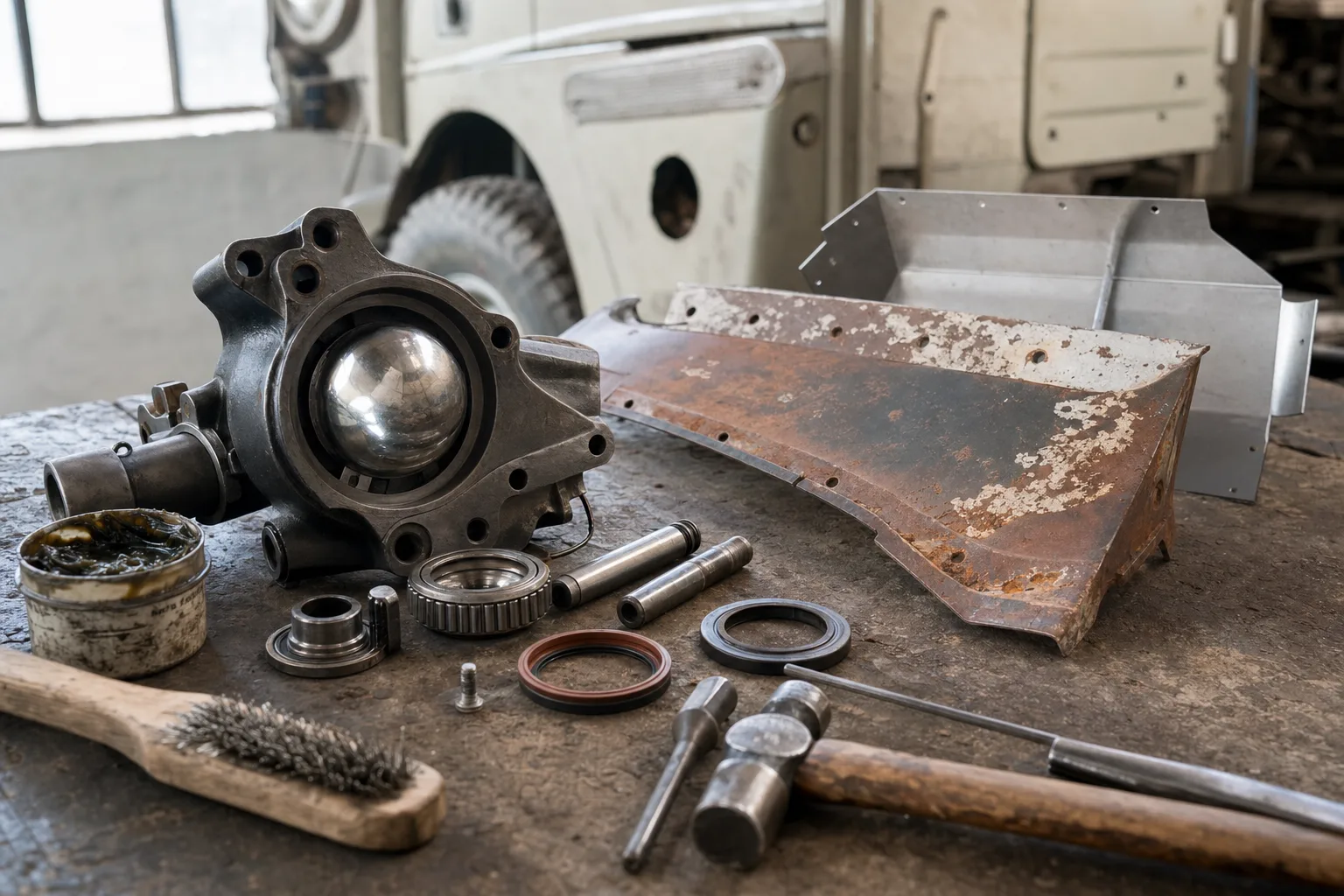
Series II Chassis & Bulkhead Panels
Outriggers, crossmembers, bulkhead footwell repair sections and mounting brackets for the Series II and IIA — the steel that keeps the body attached. Tell us your chassis number and we'll match the right panels.
Get a Quote2. Bulkhead rot (footwells, door pillars and vent flaps)
The bulkhead is the steel firewall that carries the windscreen, steering, pedals and door hinges — and it is the second great rust trap on a Series II. Water runs down the windscreen and collects in the footwells, so the bottom corners, the door top-hinge mounts and the vent-flap areas rot from the inside out.
A fully rotten bulkhead is a serious repair because so much bolts to it, and a complete replacement bulkhead is one of the pricier single parts for these trucks. Sagging doors that won't line up are the classic warning sign.
The good news is that you rarely need a whole new bulkhead — the footwells, capping rails and hinge mounts are all available as repair sections that a competent workshop can let in and weld. Catching it early, before the rot spreads into the top rail, is the difference between an afternoon's work and a full rebuild.
Solid reconditioned and repaired bulkheads do come up for the Series II and IIA, and they are worth hunting down when a project's original is too far gone to save.
3. Swivel balls and kingpin wear (steering slack and oil leaks)
The front axle uses large chrome swivel balls that steer the wheels, and inside them the kingpins and bearings carry the load. Over the years the chrome pits, the kingpin bearings wear, and the swivel seals harden — and then two things happen: the steering develops slack and a vague, wandering feel, and axle oil weeps out of the swivel and onto the brake drums.
Oil on the shoes means poor, grabby braking, so a leaking swivel is a safety issue, not just an untidy one. Feel for play at the road wheel and look behind the front wheels for that tell-tale oily film.
This is a satisfying job to put right and it is not expensive. A reconditioned swivel housing with new chrome balls, kingpins, bearings and seals restores tight, predictable steering and stops the leak at source. It is one of the most common things we quote on for these trucks, and doing both sides together makes sense while you're in there. Browse our Series II chassis and running-gear parts or send us your details and we'll match the correct swivel kit.
4. 2.25 petrol and diesel engine niggles (overheating and oil leaks)
The 2.25-litre petrol and 2.25-litre diesel four-cylinder engines fitted to most Series IIAs are genuinely tough, long-lived units — but they are old, and heat and oil are the recurring themes. Overheating usually traces back to a furred-up radiator, a tired thermostat or a weak water pump rather than anything internal, and in the SA heat a Series II that runs hot when it's working hard needs its cooling system sorted properly.
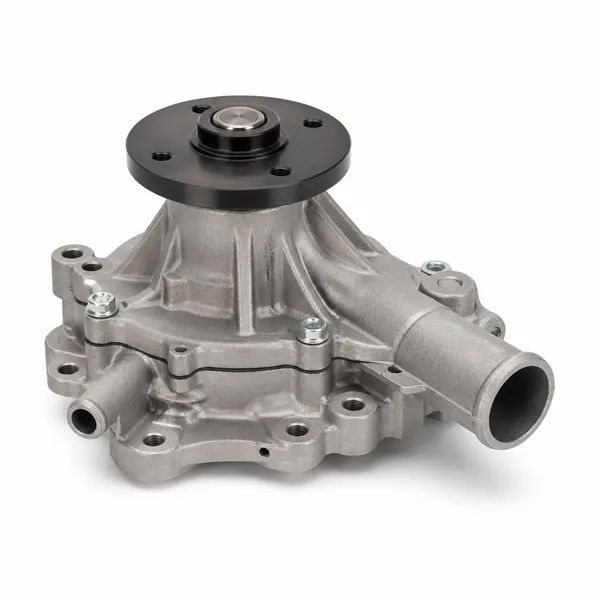
Oil leaks from the rocker cover, timing cover and rear crank seal are almost a given on a high-mileage motor, and a smoky diesel often just needs injectors and glow plugs seen to.
None of this is a reason to panic — these engines were designed to be rebuilt on a farm bench. What matters is not ignoring overheating, because cooking a Series II head can crack it. A proper radiator recore or replacement, a new thermostat and water pump, and a fresh set of gaskets keep them running for decades.
You'll find reconditioned water pumps, radiators, gaskets and timing parts among our Series II engine parts, and we can advise on the differences between the petrol and diesel setups.
Series II 2.25 Engine Parts
Reconditioned water pumps, radiators, thermostats and full gasket sets for the 2.25 petrol and diesel — the parts that cure overheating and oil leaks. Tell us petrol or diesel and we'll match your engine.
Get a Quote5. Brakes and drums (weak, grabby stopping)
A Series II stops on drum brakes all round, and by modern standards they were never powerful even when new. Age makes it worse: the wheel cylinders seize or seep, the shoes glaze or get contaminated with swivel oil, the drums score, and the flexible hoses perish and swell shut.
The result is a long, soft pedal, pulling to one side, or brakes that grab. On a heavy old truck that you might use to tow or carry a load, weak brakes are the fault to fix before any other cosmetic job.
The whole system is cheap and simple to overhaul. New wheel cylinders, shoes, drums where needed, flexible hoses and a fresh master cylinder transform the way a Series II stops, and none of it is expensive in used or reconditioned form.
It's a job we quote on constantly, and it pairs naturally with the swivel work since oil contamination from a leaking swivel is such a common cause of a dud brake in the first place. Sort the leak and the brakes together and you'll have a truck you can actually trust in traffic.
6. Wiring, earths and age-related electrical gremlins
The Series II electrical system is about as simple as a vehicle gets, but six decades of damp, vibration and amateur "improvements" leave their mark. The usual gremlins are corroded earth straps, brittle cloth-loom wiring that shorts or goes open-circuit, tired dynamos or the early alternators, and dim lights caused by bad connections rather than blown bulbs.
Many a "dead" Series II is simply a bad earth or a corroded connector, not a serious fault. Some IIAs were converted from positive to negative earth over the years, which trips people up when they start fault-finding.
The fix is patient, honest work rather than expensive parts: clean and remake the earths, replace perished sections of loom, and sort the charging system with a reconditioned dynamo or a sympathetic alternator conversion. Because everything is accessible and there are no modules to code, most owners can tackle this themselves with a test lamp and a wiring diagram.
Restoring good used and reconditioned parts for the Land Rover Series II range keeps these trucks reliable without modernising away their character. If you're comparing generations, our rundown of the later Series III's known issues shows how much of this carried straight over.
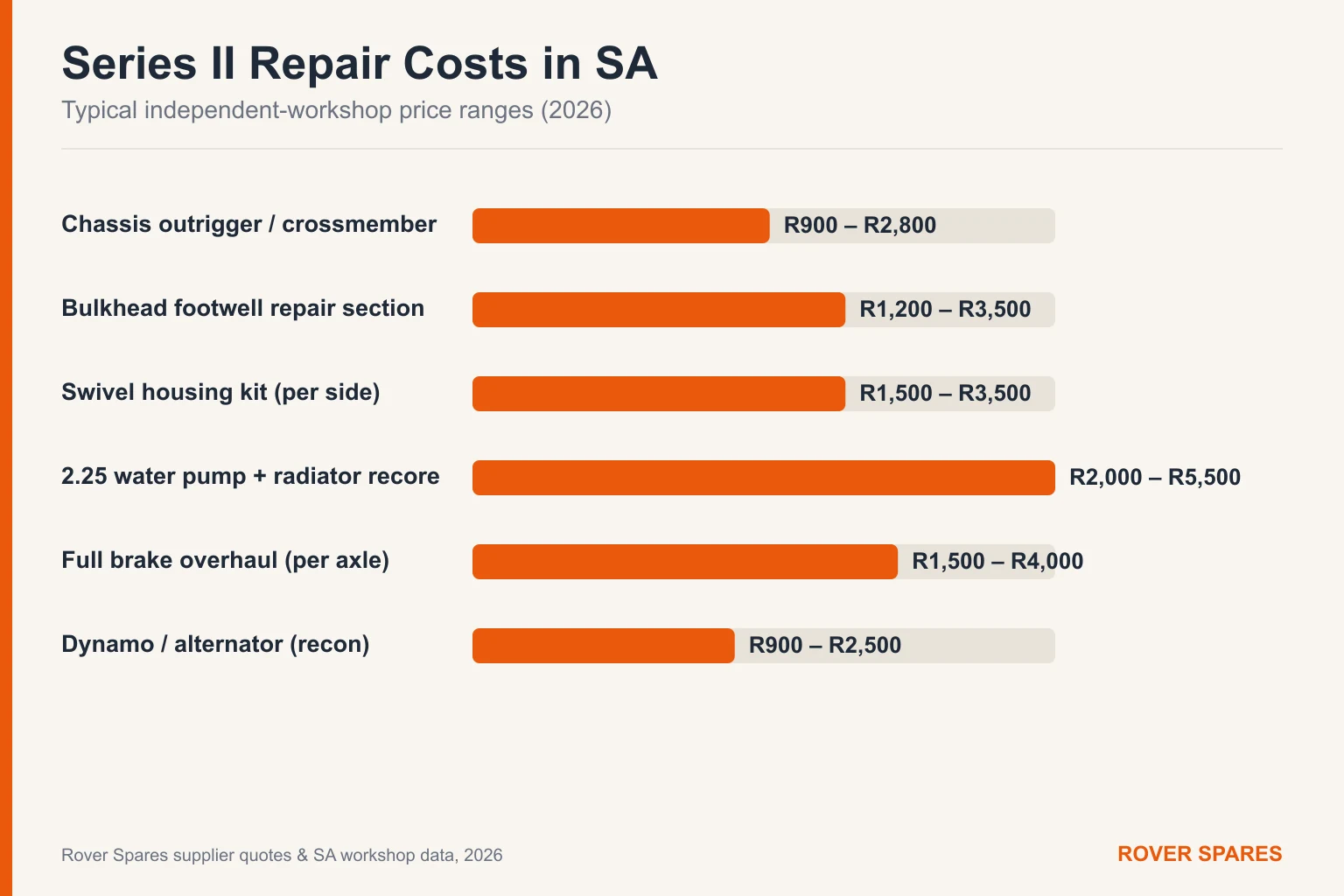
How much do Series II repairs cost in SA?
Here's a realistic guide to what these repairs run using quality used or reconditioned parts at an independent workshop — not classic-specialist dealer pricing. Actual figures depend on your exact model, condition and labour rates, but this is the ballpark our suppliers quote in 2026.
| Repair | Typical part price (used / recon) | Notes |
|---|---|---|
| Chassis outrigger / crossmember panel | R900 – R2,800 | Per section, before welding |
| Bulkhead footwell repair section | R1,200 – R3,500 | Full bulkhead far dearer |
| Swivel housing kit (per side) | R1,500 – R3,500 | Ball, kingpins, seals |
| 2.25 water pump + radiator recore | R2,000 – R5,500 | Cures overheating |
| Full brake overhaul (per axle) | R1,500 – R4,000 | Cylinders, shoes, hoses |
| Dynamo / alternator (recon) | R900 – R2,500 | Charging system fix |
What we see in the workshop
Work a Series II front end in order or you will pay for it twice. Oil on the front brakes, heavy steering and wandering on the road all point at the swivels, but a worn steering relay, slack in the drag link and tired kingpins give much the same feel from behind the wheel. Check the cheap ends of that list first. Where the swivels genuinely are the problem, reconditioned housings with fresh chrome balls, kingpins and seals do exactly the same job as new parts for a fraction of the outlay, and supply is still good.
Need Series II parts? Get a same-day quote.
We supply tested used and reconditioned Land Rover Series II and IIA parts across South Africa — chassis and bulkhead panels, swivels, 2.25 engine parts, brakes and electrics — with nationwide delivery. Send us your chassis number and the part you need.
Frequently asked questions
Is the Land Rover Series II reliable?
Mechanically, yes — the Series II is about as simple and dependable as a vehicle gets, with no electronics to fail and engines designed to be rebuilt on a farm bench. What lets them down is age, not design: chassis and bulkhead rust, worn swivels, tired brakes and perished wiring.
A Series II with a sound chassis and those known items sorted will run for decades. Buy on the condition of the steel underneath, not the shine of the aluminium body, and budget for a round of catch-up jobs.
What is the most common Series II problem?
Corrosion of the steel chassis and bulkhead, without question. The aluminium body barely rusts, which fools buyers, but the outriggers, crossmember, spring hangers and bulkhead footwells rot with age and trapped mud. It's also the most expensive area to put right if it's been ignored, so always inspect the chassis with a torch and a spike before you buy.
Is the 2.25 petrol or the 2.25 diesel better?
For most SA owners the 2.25 petrol is the easier live-with — smoother, quicker to start and simpler to work on, with plentiful parts. The 2.25 diesel is slower and noisier but sips fuel and has huge low-down grunt, which suits farm and load work. Both are tough and rebuildable; parts for either are affordable used and reconditioned. Whichever you pick, check the cooling system and look for oil leaks first.
Are Series II parts hard to find in South Africa?
No — the Series II and IIA are among the best-supported classic Land Rovers for parts. Because so many were sold and the mechanicals are shared across the Series range, quality used and reconditioned chassis panels, swivels, engine parts, brakes and electrics are readily available here. Buying from a specialist that tests its stock is the key to keeping a restoration affordable rather than chasing new-old-stock at premium prices.
How do I check a Series II chassis before buying?
Get underneath with a torch and a blunt screwdriver. Prod the outriggers, the rear crossmember, the front dumb-irons and the spring hangers — sound steel rings, rotten steel gives or flakes. Check the bulkhead footwells and door hinge mounts from inside the cab, and look for doors that sag or won't line up, which points to a rotten bulkhead. Surface rust is fine on a truck this age; soft, flaking or previously-bodged steel is the warning sign.
Is a Series II worth restoring in SA?
Absolutely, if the chassis and bulkhead are sound or the price reflects the work needed. Values for good Series IIAs have climbed, the trucks are genuinely usable, and the simplicity means much of the work is DIY-friendly. The maths works when you buy the parts smart — reconditioned swivels, a radiator recore and a brake overhaul cost a fraction of specialist-dealer figures, and doing it once properly is far cheaper than buying someone else's unfinished project.
Sources
- Wikipedia — Land Rover Series (I, II, III) model history, engines and production dates: en.wikipedia.org
- Land Rover Series FAQ — technical data on the 2.25 petrol and diesel engines and their known service points: lrfaq.org
- Classic & Sportscar — Land Rover Series II/III buying and ownership guide: classicandsportscar.com