
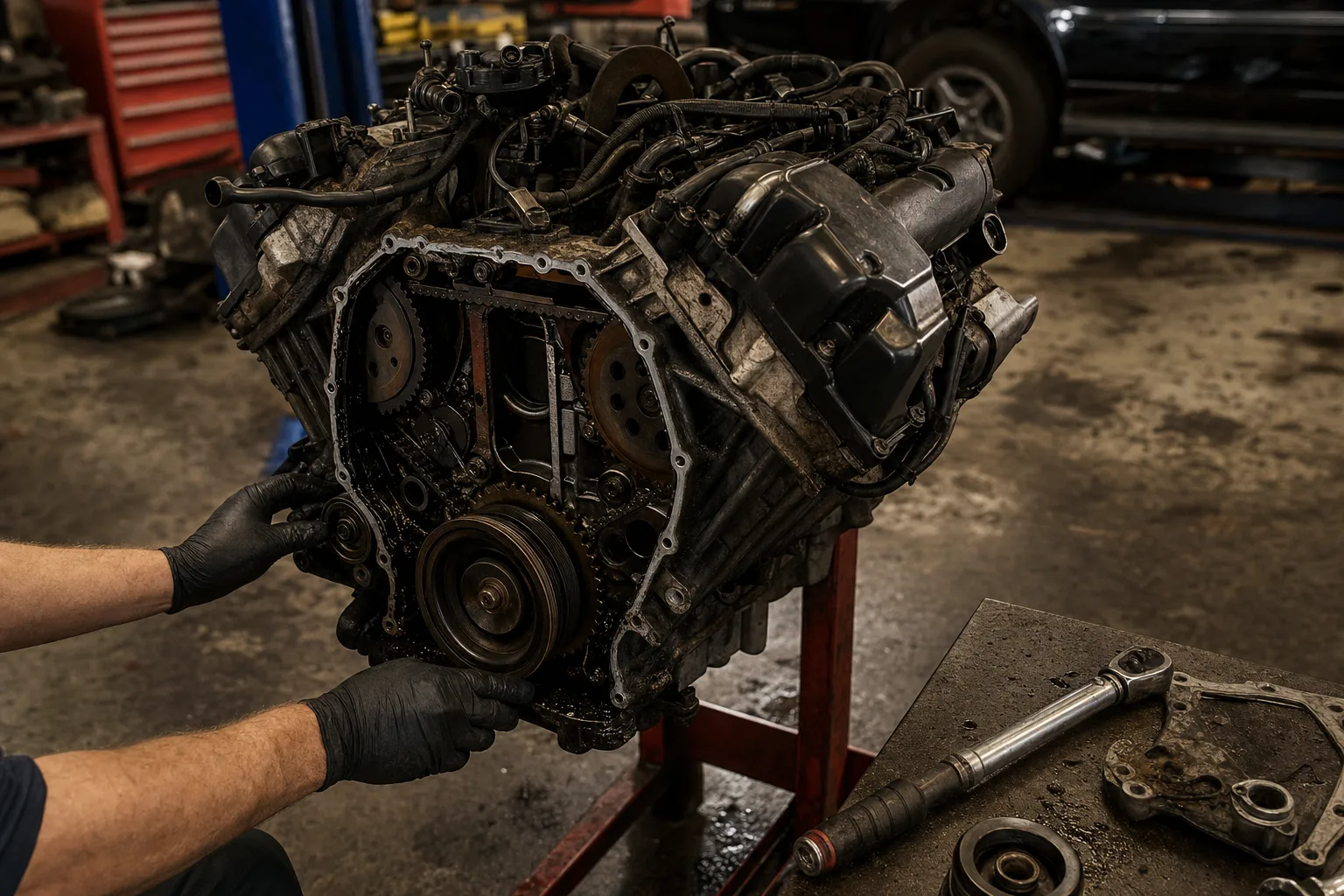

The 2.7-litre TDV6 (the "Lion" diesel, engine code 276DT) is the engine that put the Land Rover Discovery 3 and early Range Rover Sport within reach of ordinary South African buyers — strong low-down torque, a lovely muted V6 growl and real towing muscle. It is also an engine with a handful of well-known weak spots that, left unchecked, can end in a very expensive morning.
The good news is that every one of those faults is documented, predictable, and far cheaper to sort with quality used or reconditioned parts than with dealer prices. Below are the six problems that come up most on the 2.7 TDV6, what they cost to put right in SA, and how to spot a bargain engine from a grenade waiting to go off.
- The 2.7 TDV6 is an interference engine with a rear-mounted timing belt — if the belt or its tensioner lets go, valves meet pistons and the repair bill jumps to engine-replacement territory.
- The front crankshaft pulley (harmonic balancer) perishes with age and is the cheapest, most important thing to catch early — a knock from the front of the engine is your warning.
- Watch the turbo actuator, injector seals ("black death" carbon leak) and the EGR / oil-cooler circuit — these three cause most of the limp-mode and oil-in-coolant scares.
- Most repairs are far cheaper with tested used or reconditioned parts: a turbo actuator kit runs about R2,500–R5,500 fitted versus a full turbo replacement at a dealer.
- A pre-purchase diagnostic scan plus an oil-and-coolant check tells you more about a 2.7 TDV6 than any test drive will.
1. Crankshaft pulley (harmonic balancer) failure
This is the fault that catches the most owners out because it is so cheap to fix if you catch it, and so ruinous if you don't. The 2.7 TDV6 uses a front crankshaft pulley with a rubber isolating layer that damps engine vibration. With age, heat and kilometres that rubber perishes and starts to separate, so the outer ring wobbles on the hub.
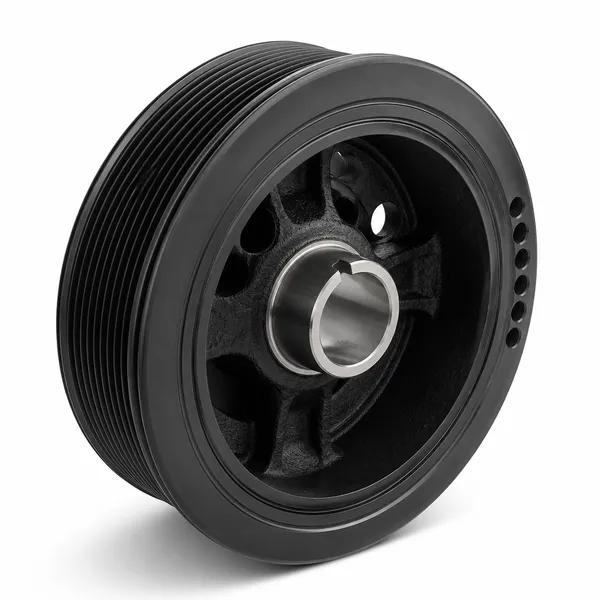
You'll hear a rattle or knock from the front of the engine, and the accessory belt may start to wander on its pulleys. Because the crank pulley sits right at the front of the timing case, a badly failed balancer can shed the belt and upset everything downstream of it.
The fix is genuinely cheap insurance: replace the pulley the moment it shows play or noise. On a 2.7 TDV6 with no service history, inspect it first, and if you're buying, factor it in. The same principle carries over to the wider Discovery 3 problem list, where this pulley is a recurring theme. Don't ignore a front-end knock on this engine — it rarely gets cheaper by waiting.
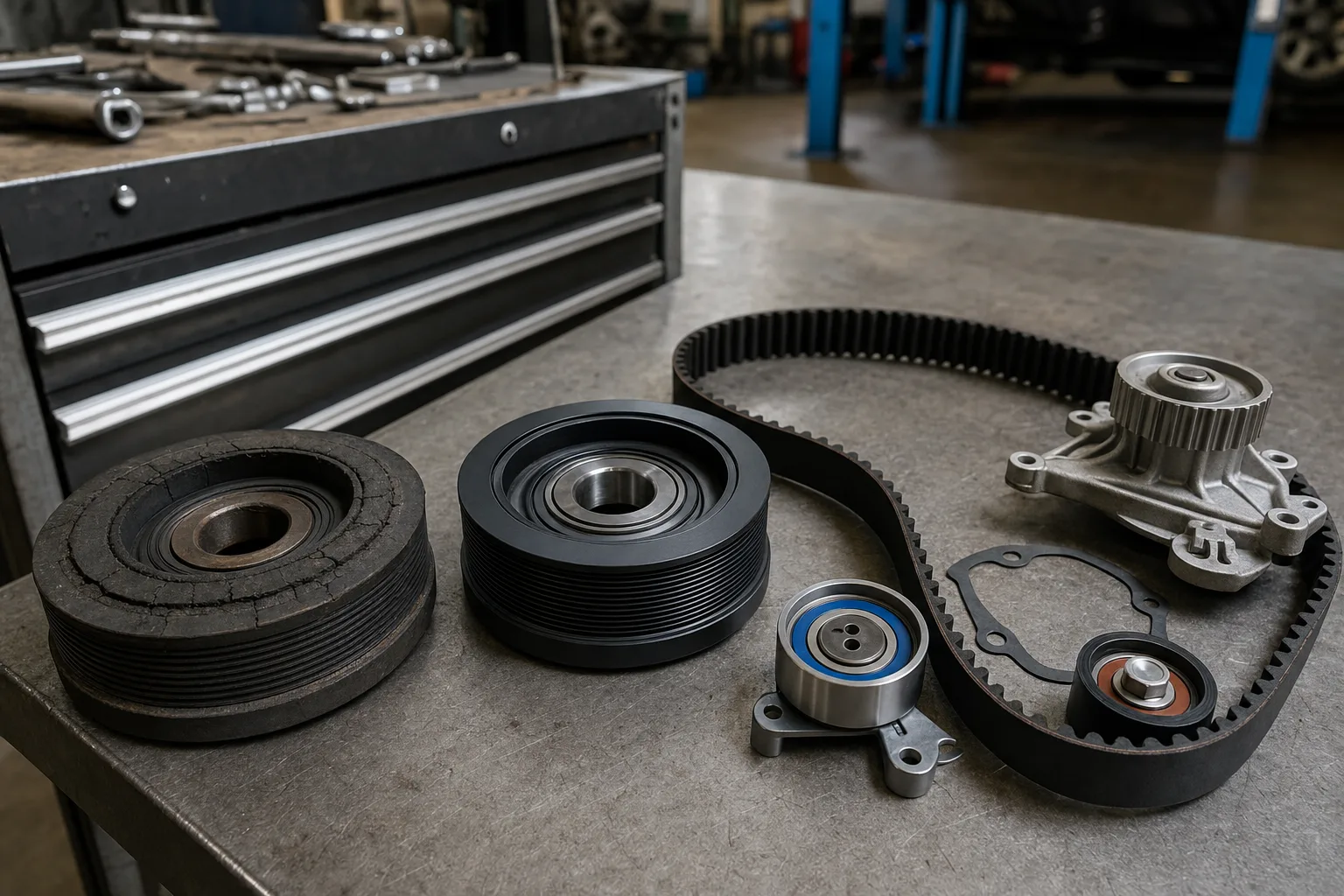
2.7 TDV6 Crank Pulley & Timing Kit
Crankshaft pulleys, timing belt kits, tensioners and water pumps for the 276DT — the parts you fit together to reset a high-mileage Lion engine. Send us your VIN and we'll match the exact set.
Get a Quote2. Rear timing belt, tensioner and oil-pump housing
The 2.7 TDV6 is unusual in that its timing belt lives at the back of the engine, against the bellhousing, which makes it a labour-heavy job and one that gets skipped by owners who don't know it exists. It is also an interference design, so if the belt jumps or snaps, the valves and pistons collide and the damage usually means a full engine rebuild or a replacement unit.
The known weak point is the timing belt tensioner, which bolts to the oil-pump housing; that boss can crack and let the belt jump teeth. Skip the belt interval on a 276DT and you are gambling the whole engine.
Our advice is blunt: on any 2.7 TDV6 with unknown history, treat the rear timing belt, tensioner, idlers and water pump as one package and do them together. It is the single most important preventative job on this engine. When you have the front apart anyway, fitting quality reconditioned TDV6 engine parts in one go is far cheaper than paying the labour twice — and infinitely cheaper than a bent-valve rebuild.
3. Turbo actuator and turbocharger faults
The TDV6's variable-geometry turbo relies on an electronic actuator to move the vanes and control boost. Over time the actuator sticks or its linkage corrodes, and the vane mechanism gums up with soot, giving you limp mode, a flat spot, a loss of power on a hill, or a whistling and fluttering noise under load.
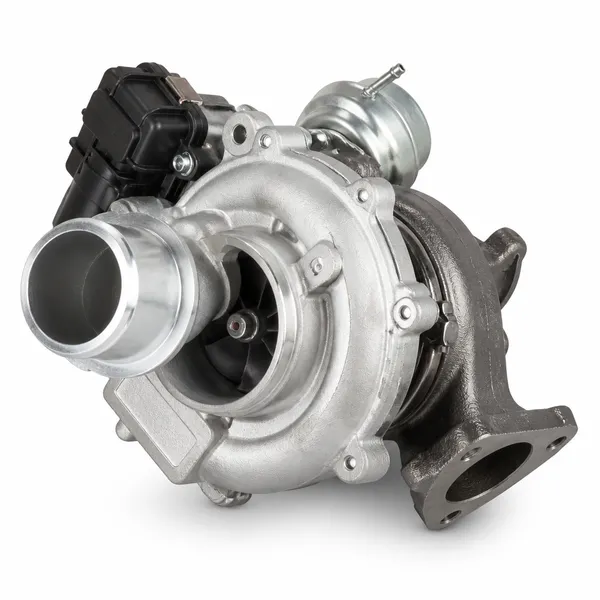
Land Rover even sells a dedicated actuator service kit (the actuator pin and connecting rod), which tells you how routine this fault is. A diagnostic scan usually points straight at it with boost-pressure or actuator fault codes.
Don't assume every power loss on a 2.7 TDV6 means a scrap turbo. Nine times out of ten it is the cheaper actuator, a soot-blocked EGR, or a split intercooler hose first — a proper diagnosis before you buy parts saves thousands.
When the turbo genuinely is tired, a reconditioned unit restores full performance for a fraction of new. The later twin-turbo motor covered in the 3.0 TDV6 problem guide shares the same actuator logic, so the diagnostic approach is identical.
4. Injector seals and "black death" leaks
The 2.7 TDV6's injectors sit deep in the cylinder heads, sealed by copper washers at the tip and rubber spill-line seals up top. As those seals age they leak, and combustion gases blow past the copper washer to bake a hard, tar-like carbon deposit around the injector — the fault owners nickname "black death".
You'll often smell diesel, find a sooty crust around an injector, or get a misfire and rough running because the injector is no longer sealing properly. The rear injectors are the usual culprits and the awkward ones to reach.
Caught early it is a seal-and-clean job; left too long, the carbon can seize an injector into the head and turn a routine service into serious surgery.
On a used purchase, a quick look for that black crust around the injectors is one of the most useful five-minute checks you can do. We supply injectors, copper washers and spill-line seal kits for the 276DT, and we'll always tell you honestly whether a clean-up or a full set is what you actually need.
2.7 TDV6 Injectors & Seal Kits
Reconditioned and tested injectors, copper washers and spill-line seals to cure a leaking, "black death" 276DT. Give us your engine number and we'll match the correct part.
Get a Quote5. EGR clogging and oil-cooler failure
Like most modern diesels the 2.7 TDV6 recirculates exhaust gas, and over years of short trips the EGR valves and inlet tract clog with an oily carbon sludge — you get rough idle, hesitation, poor economy and a warning light.
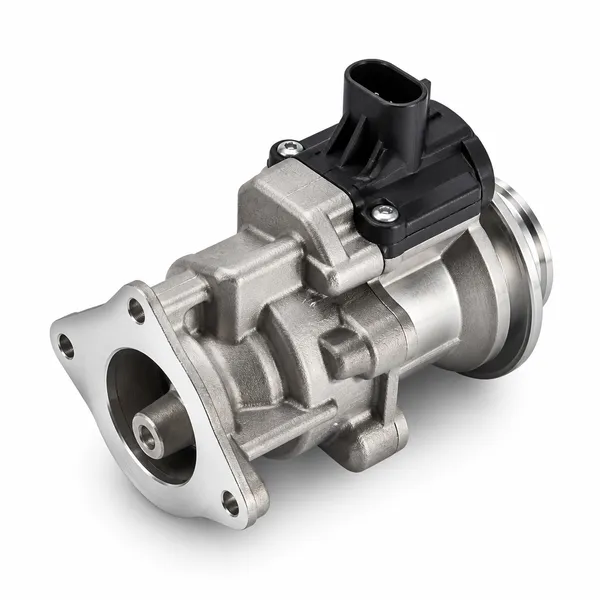
More seriously, this engine's EGR circuit is water-cooled, and when the oil cooler or its seals let go, oil and coolant mix. The classic warning sign is a thick black or milky sludge in the coolant header tank. If you see that, stop driving: mixed fluids can starve bearings and destroy the engine.
Often a clean and a fresh set of EGR valves sorts the breathing side, and a reconditioned oil cooler with new seals cures the fluid-mixing side before it does any harm. What you must not do is ignore either symptom, because both can hide a bigger fault.
When you're weighing up a 2.7 against its successor, the same cooling-circuit lessons apply to the Land Rover Discovery range as a whole, which shares much of this driveline. A proper motorway run now and then genuinely helps keep the EGR side cleaner for longer.
6. Oil starvation, crankshaft and bearing wear
The most serious 2.7 TDV6 failures trace back to oil supply. On start-up this engine can take a couple of seconds to build full oil pressure, and if the oil pickup pipe is partially blocked with sludge or servicing has been stretched, the main bearings suffer.
In the worst cases the crankshaft can crack between the main bearings, which is effectively the end of that engine's economic life. It is not a fault of a well-maintained motor — it is almost always the end result of neglect, a leaking oil cooler contaminating the oil, or missed services.
Prevention is straightforward and cheap relative to the alternative: change the oil and both filters on time with a good synthetic, keep the EGR and cooling circuits healthy so nothing contaminates the oil, and listen for bottom-end knock on a cold start.
If an engine is already tired, a tested reconditioned 2.7 TDV6 long block or complete unit is far more sensible than pouring money into a failing one. We can quote either the specific part or a full engine, whichever the diagnosis calls for.
How much do 2.7 TDV6 repairs cost in SA?
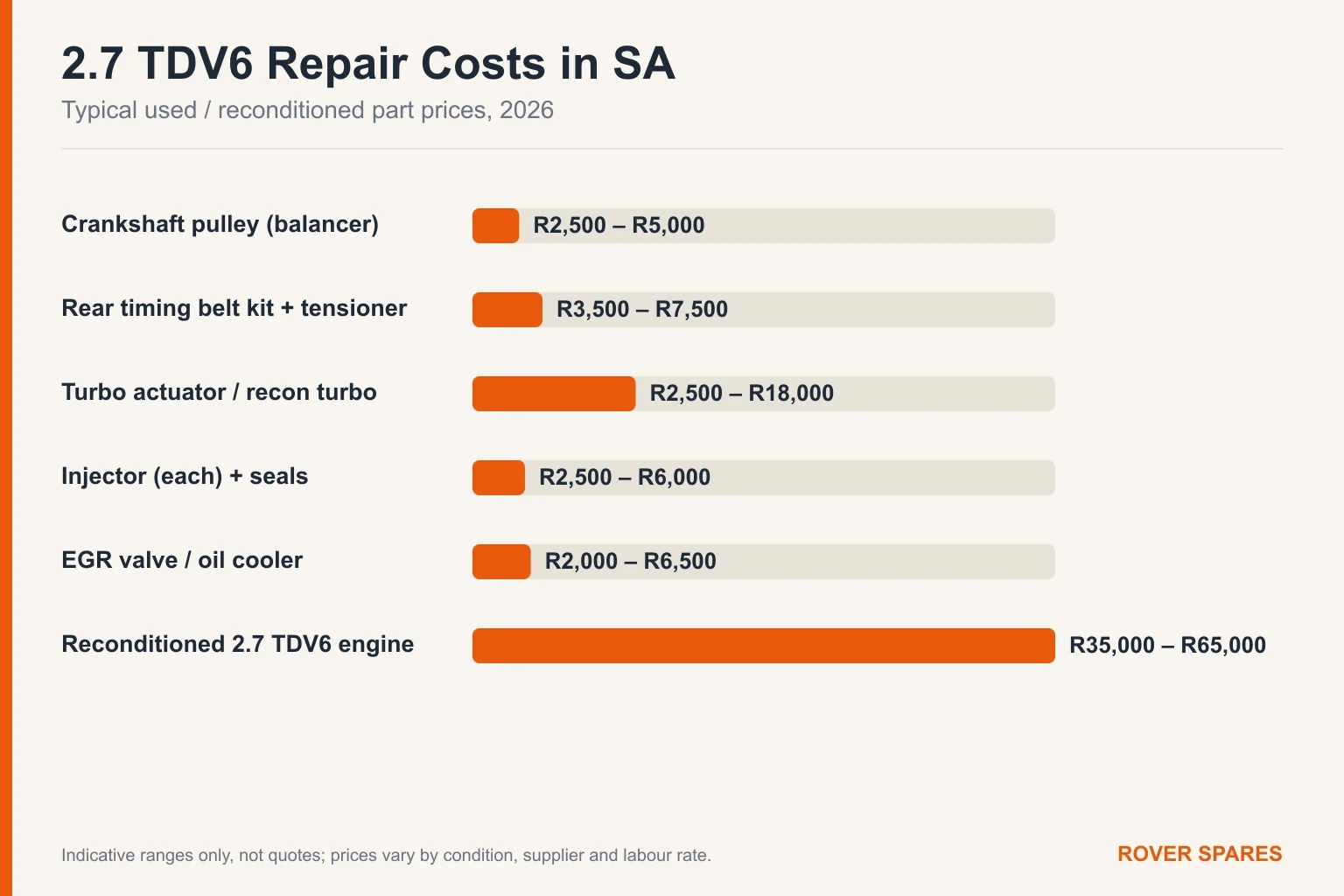
Here's a realistic guide to what these repairs run using quality used or reconditioned parts at an independent workshop — not dealer pricing. Actual figures depend on your exact model, condition and labour rates; these are indicative ranges only, not quotes.
| Repair | Typical part price (used / recon) | Notes |
|---|---|---|
| Crankshaft pulley (harmonic balancer) | R2,500 – R5,000 | Do with belt + water pump |
| Rear timing belt kit + tensioner | R3,500 – R7,500 | Labour-heavy; interference engine |
| Turbo actuator / recon turbo | R2,500 – R18,000 | Actuator kit often enough |
| Injector (each) + seals | R2,500 – R6,000 | Rear ones the awkward ones |
| EGR valve / oil cooler | R2,000 – R6,500 | Check coolant for oil first |
| Reconditioned 2.7 TDV6 engine | R35,000 – R65,000 | Vs new dealer money |
Before you buy parts
Plenty of 2.7 TDV6 owners have already been told the engine is finished, and some of them have been told correctly. The question worth asking before sourcing anything is what killed it, because dropping in a replacement without answering that simply buys the same failure again. Oil supply and servicing history tell you more about one of these engines than the odometer does. When you do buy used, insist on a unit that has been tested rather than merely pulled, and price the ancillaries in at the same time rather than discovering them later.
Need 2.7 TDV6 parts? Get a quote.
We supply used and reconditioned Land Rover 2.7 TDV6 parts across South Africa — crank pulleys, timing kits, turbos, injectors, EGR and oil coolers, right up to complete engines — with nationwide delivery. Send us your VIN and the part you need.
Frequently asked questions
Is the Land Rover 2.7 TDV6 a reliable engine?
The 2.7 TDV6 is a strong, torquey diesel that can comfortably pass 300,000 km when it is looked after. Its faults — the crank pulley, rear timing belt, turbo actuator, injector seals and the EGR/oil-cooler circuit — are all well documented and preventable.
A well-serviced 276DT is dependable; a neglected one, with a stretched timing-belt interval or a leaking oil cooler, is where the horror stories come from. Buy on history and condition, and budget to catch up the known items early.
What is the most common 2.7 TDV6 problem?
The crankshaft pulley and the rear timing belt are the two that matter most. The pulley perishes with age and warns you with a front-end knock; the rear timing belt is an interference-engine item that must be changed on schedule or the whole engine is at risk. Neither is expensive relative to the alternative, which is why both are worth checking first on a used 2.7 TDV6.
How often should the 2.7 TDV6 timing belt be changed?
Follow the manufacturer's service interval and do not stretch it — this is an interference engine, so a snapped belt means valve-to-piston contact and, usually, a rebuild or replacement. Because the belt sits at the back of the engine and the job is labour-heavy, it makes sense to do the belt, tensioner, idlers and water pump together while everything is apart. If you have no service history, assume it is due.
What is "black death" on a TDV6?
"Black death" is the nickname for the hard, tar-like carbon that builds up around a 2.7 TDV6 injector when its seals leak and combustion gases blow past the copper washer. It shows as a sooty black crust around the injector, often with a diesel smell or a misfire. Caught early it is a seal-and-clean job; left too long the injector can seize into the head, so it is worth checking on any used purchase.
Are 2.7 TDV6 parts expensive in South Africa?
New dealer parts are dear, but that is not your only option. Quality used and reconditioned parts cut the cost sharply — a turbo actuator kit for a few thousand rand instead of a full turbo, injectors and seals rather than a new set at dealer money, even a reconditioned complete engine for a fraction of new. Buying from a specialist that tests its stock is the key to running a 2.7 TDV6 affordably.
Is it worth fitting a reconditioned 2.7 TDV6 engine?
If the bottom end is tired — bearing knock, low oil pressure, or a cracked crank — a tested reconditioned engine is far more sensible than chasing repairs on a failing unit. In SA a good recon 2.7 TDV6 typically lands well below a new dealer engine, and a competent workshop can carry over your ancillaries. We can quote either the specific part or a complete engine, depending on what the diagnosis shows.
Sources
- Honest John — Land Rover Discovery 3 (2.7 TDV6) owner-reported good & bad points: honestjohn.co.uk
- Haynes — Land Rover Discovery common problems (2005–2017): au.haynes.com